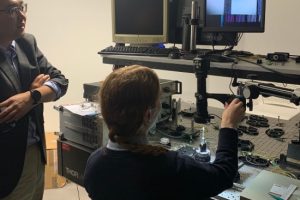

The Cardiff-based company is an advanced materials startup focusing on semiconductor manufacturing in space. It highlights the latest development as a world-first for such commercial in-space manufacturing.
Specifically, it describes ForgeStar-1 “as the first free-flying commercial semiconductor manufacturing tool ever operated in space”.
Crystal growth
A demonstration confirmed the conditions needed for gas-phase crystal growth – that they can be created and controlled on an autonomous platform in low Earth orbit.
“Generating plasma on orbit represents a fundamental shift, it proves that the essential environment for advanced crystal growth can be achieved on a dedicated, commercial satellite – opening the door to a completely new manufacturing frontier,” said Joshua Western, CEO and co-founder of Space Forge.
Launching in June 2025, ForgeStar-1 was part of SpaceX’s Transporter-14 rideshare mission, from the Vandenberg Space Force Base in California.
Ultra-wide bandgap
The company has a focus on wide- and ultra-wide bandgap materials. For example, gallium nitride, silicon carbide, aluminium nitride and diamond.
On Earth, their development is constrained by defect formation, impurity incorporation and thermal instability during growth, it highlights.
Target applications for the materials include power electronics, advanced communications and quantum computing.
Next steps
Forge Star describes the ForgeStar-1’s plasma strike as the first step in testing how those advantages translate into real materials performance.
Next, the satellite will run a series of tests to map plasma behaviour in microgravity. The goal is to collect data that will directly inform the design and operation of future missions.
The company’s long-term vision, it says, is to unite orbital crystal growth with terrestrial processing.
In other words, space-grown material will return to Earth and then be scaled at Swansea University’s Centre for Integrative Semiconductor Materials.
The aim is to create a hybrid manufacturing model that complements existing supply chains, producing materials of a quality not achievable on Earth.
Space Forge
In September last year Space Forge and United Semiconductors LLC signed a Memorandum of Understanding.
Targeting previously mentioned applications, the plan is develop specific project frameworks with strategic long-term customers.
Specifically, Space Forge is developing advanced materials deposition processes and equipment. These will be compatible with its ForgeStar satellite platform. United Semiconductors will contribute its crystal growth processes and design specialised equipment for in-space manufacturing environments.
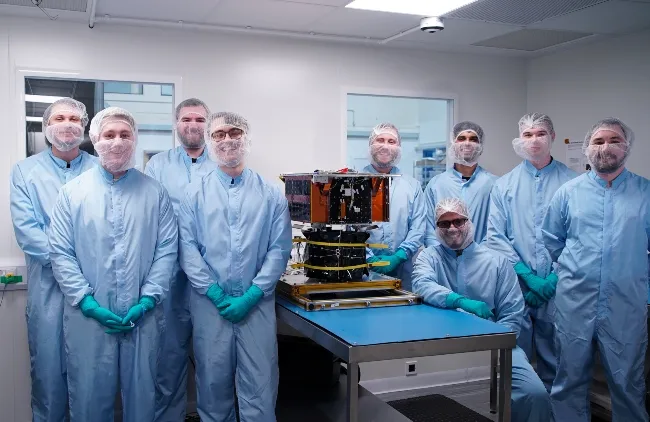
Images: Space Forge – (top) image of first plasma generated on ForgeStar-1 (bottom) the company’s manufacturing team