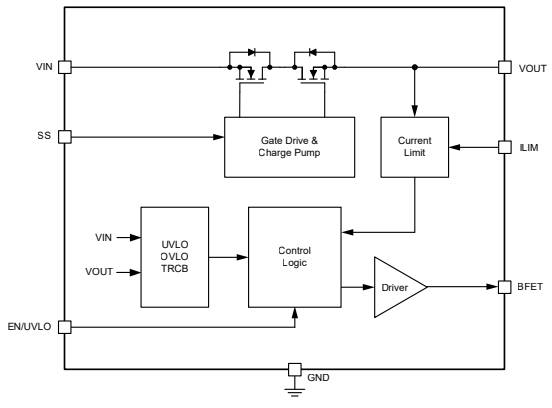
Dubbed AOZ18101DI, they come in 3 x 3mm DFN system-in-packages containing a control IC and back-to-back trench mosfets.
The internal mosfets are n-channel, biased using a built-in charge pump.
“The eFuse continuously monitors the current flowing through the power switch,” said AOS. “If the current is higher than the set limit, the switch will limit the current to the maximum allowed. If the high current load persists, the switch will eventually turn off, protecting downstream loads from damage, thus acting as a fuse.”
There are four parts (table below), with two of them incorporating reverse current blocking (the company calls this ‘true reverse current blocking’) against fault conditions when Vout is higher than Vin.
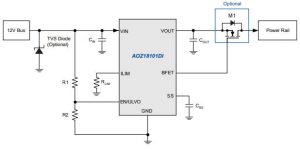
While the IC does not need an external blocking mosfet, control for an external n-channel blocking FET [diagram left] is included to make the chip drop-in compatible with designs already in production using an eFuse that needs an external fet.
For loads with high inductive kickback – disc drives and fans, for example – the other two have reverse current blocking disabled “to avoid shut-down of the input power bus due to a reverse current,” said AOS.
At least a 10μF ceramic capacitor is needed at the input, plus sufficient capacitance at the output to handle fast transient loads.
All devices have start-up safe-operating-area management, capacitor-programmable soft-start, under-voltage lock-out, over-voltage clamp, thermal shutdown and over-current protection.
Operation is over 3.5 to 14V (22V abs max)
| Part | Reverse current blocking |
Fault recovery |
| AOZ18101DI-01 | built-in | auto-restart |
| AOZ18101DI-02 | built-in | latch-off |
| AOZ18101DI-03* | inactive | auto-restart |
| AOZ18101DI-04 | inactive | latch-off |
*scheduled for later this quarter