University of Glasgow
The University of Glasgow is a research powerhouse in electronics, focusing on nanotechnology, quantum circuits, and bioelectronics. Known for its pioneering work in flexible electronics and neuromorphic systems, the university collaborates with industry partners to push boundaries in device innovation. Recent projects include energy harvesting sensors, graphene applications, and 6G-enabling technologies. Its impact on the global research landscape makes University of Glasgow news a valuable source of breakthroughs influencing future product development.
Posted on 6th February 2026 | Modified on 6th February 2026
EW BrightSparks
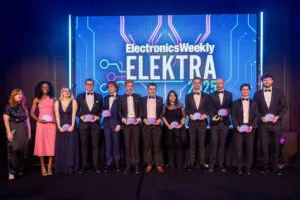
Now in its eighth year of awards, EW BrightSparks sees Electronics Weekly highlight and celebrate some of the brightest and most talented young engineers in the UK today. In the next in our series on the latest EW BrightSparks of 2025, we profile Harry Ford, a Test Bench and GSE Engineer at HyImpulse. Achievements Harry was nominated for the award by ...
Posted on 22nd January 2026 | Modified on 22nd January 2026
Latest news
Our choices include the University of Glasgow researching compostable circuit boards, Malcolm Penn having positive news on the semiconductor market, and tough times in Taiwan's semiconductor supply chain...
Posted on 21st January 2026 | Modified on 26th January 2026
Materials R&D, News, Recycling, University Electronics, WEEE Directive
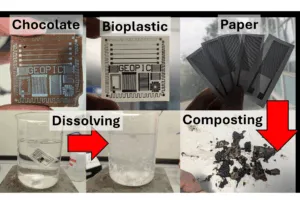
Circuit boards that are almost entirely biodegradable have been developed by researchers at the University of Glasgow, electroplating circuitry onto compostable substrates – including chocolate. Instead of conventional circuit boards that are sent to landfill, adding to the problem of electronic waste, the team has developed a method to print zinc-based electronic circuits on environmentally-friendly surfaces such as paper and ...
Posted on 6th January 2026 | Modified on 6th January 2026
EW BrightSparks, Research
Now in its eighth year of awards, EW BrightSparks sees Electronics Weekly highlight and celebrate some of the brightest and most talented young engineers in the UK today. In the second in our series on the latest EW BrightSparks of 2025, we profile Nikolas Bruce, a PhD Research Student at University of Glasgow. Achievements Nikolas was nominated by his supervisor ...
Posted on 27th June 2025 | Modified on 3rd September 2025
Elektra Awards, News, University Electronics
We are asking readers of Electronics Weekly to choose the winner of the University Research Project of the Year in this year’s Elektra Awards. You are invited to select – from below – the research project from the last year that you feel will make the largest impact on the commercial market in the next five years. The five universities ...
Posted on 14th April 2025 | Modified on 16th April 2025
Research
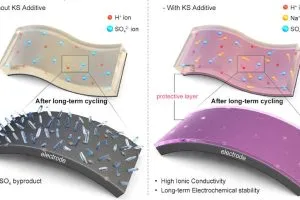
The University of Glasgow has found a way to stabilise aqueous supercapacitors, using a gum taken from the bark of an Indian tree. It’s research team started with a simple supercapacitor made from carbon-based electrodes with a sulphuric acid electrolyte. While not a commercial formulation, it is “one kind of which is mostly researched in the conventional supercapacitor literature” Jun ...
Posted on 1st April 2025 | Modified on 1st April 2025
Research
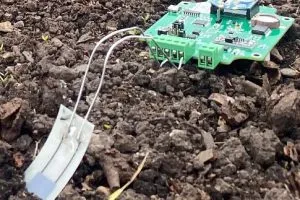
The University of Glasgow has created a pH sensor for soil testing that can be composted at the end of its life. It is an impedance-based sensor, using screen-printed interdigitated carbon-based electrodes on a substrate made from the bio-degradeable polymer PHBV (poly(3-hydroxybutyrate-co-3-hydroxyvalerate)). Also deposited using screen-printing, the sensitive layer over the electrodes is molybdenum disulfide which, said the university, breaks down ...
Posted on 10th March 2025 | Modified on 20th March 2025
Finance, Military/Aerospace Electronics, Research
The European Space Agency (ESA) is funding £10 million for new facilities at the UK Astronomy Technology Centre (ATC), the research institute in Edinburgh. Specifically, new lab spaces will be built to assemble optical benches. These are for the Laser Interferometer Space Antenna (LISA) mission, investigating gravitational waves in space. The investment will approximately double UK ATC’s construction capabilities. Optical ...
Posted on 28th February 2025 | Modified on 28th February 2025
Research, University Electronics
Built with £250,000 of investment, Glasgow University has opened a state-of-the-art magnetism lab for medical magnetics research. Part of the James Watt School of Engineering, the facility is designed to eliminate magnetic interference from any external sources. For example, nearby electronics and even the Earth’s magnetic field. And the MuRoom within the lab will enable researchers to detect extremely weak ...
Posted on 7th February 2025 | Modified on 7th February 2025
Latest news
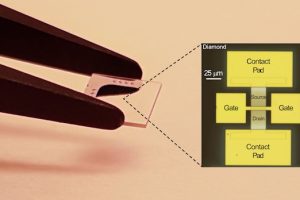
Glasgow University research into diamond transistors, a TLC NAND with 294 layers, a Mannerisms post on a retirement crisis, Cat6A data rated cables terminated in M12 circular connectors, and Intel adopting a ‘get real’ approach to its product roadmap...