12 of them are in the 7UL1G series, which operate across 0.9 to 3.6V and have input thresholds that are a ratio of the power rail up to Vdd = ~2V, above which they become fixed-voltage – see the data sheet for details.
Inputs are also 3.6V-tolerant whatever the (valid) Vdd.
These characteristics “allow a device to perform voltage translation to 0.9V for input signals ranging from 0.9V to 3.6V, even when used with a 0.9V power supply”, said the company.
Then there are nine new single gate devices in the 7UL1T series, which operate across 2.3V to 3.6V and have fixed input thresholds whatever the supply value: 1.1 – 1.2V minimum for the high threshold and 350 – 500V maximum for the low threshold voltage.
“This ensures that even low input voltages are reliably recognised as high, which is important for correctly transmitting low-voltage signals such as 1.8V to 3.3V logic systems”, said Toshiba. “When used with a 3.3V supply, a device can perform logic for input signals ranging from 1.8 to 3.6V, and voltage translation to 3.3V.”
Both of these series feature inputs and outputs that shut-down (become open-circuit) when power is removed (if the Vdd terminal reaches 0V) – leakage is a maximum of 1μA at 25°C, or 10μA across the full operating range of -40 to +85°C.
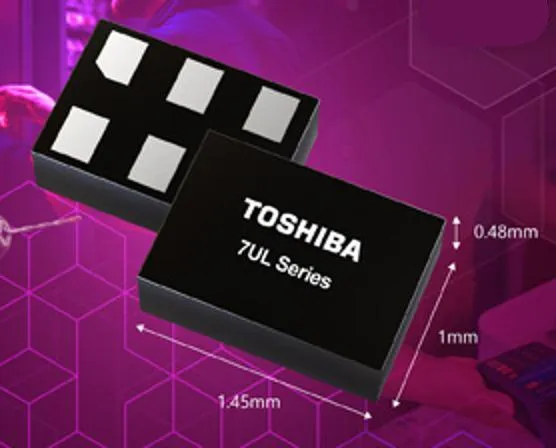
“The XSON6 package allows implementation in space-constrained environments. This contributes to reduced PCB mounting area,” said Toshiba, although it has been offers both 7UL1G and 7UL1T parts in the smaller 1 x 1mm SOT-953 package since 2019 (both packages are equally tall at 0.48mm). It also offers them in the larger 2 x 2.1 x 0.9mm SOT-353.
Example 7UL1G data sheet – check table 9.1 for the input characteristic