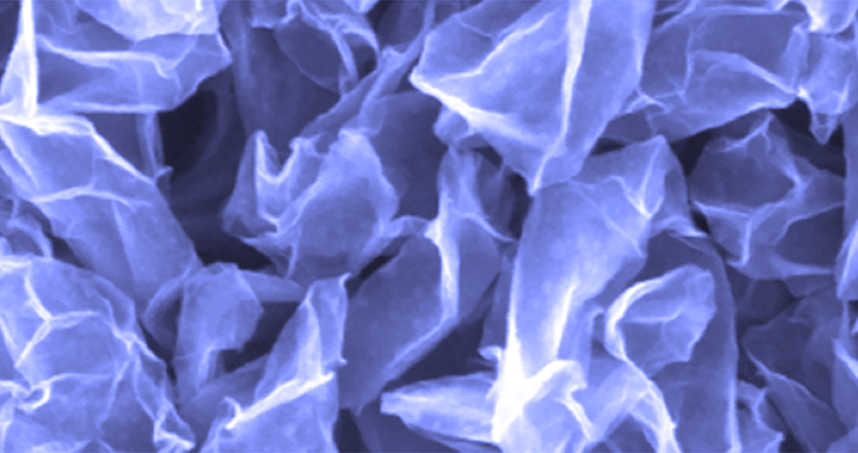
Building on work began by Jiaxing Huang, professor of materials science and engineering at Northwestern University’s McCormick School of Engineering, Jiayan Luo, professor of chemical engineering at Tianjin University of China, used crumpled graphene balls to make a scaffold that can be restacked easily to survive the stress of the fluctuating volume of lithium in the battery before dendrite can accumulate. In his original research, Huang first made the crumpled paper ball-like particles by atomising a dispersion of graphene based sheets into tiny water froplets. When the water evaporated, they generated a capillary force that ‘shrank’ the sheets into small ‘balls’.
When the battery is charging, lithium can be deposited along the surface of the scaffold, to avoid dendrite growth. Rather than try to make a structure that is unbreakable, explained Huang, the approach was to loosely stack ultra-fine graphene particles that can move apart when the lithium is deposited and reassemble when the lithium is depleted. The particles look like paper balls and are conductive for the lithium ions to flow rapidly along the surface.
Luo and Huang co-authored a research paper, published in Joule, about the research which also found that the crumpled graphene balls do not form clusters, but are evenly distributed. Compared to batteries that use graphite in the anode, the battery using graphene balls are lighter and can stablilise a higher load of lithium during the charge-discharge cycle. It also holds lithium stacked 150µm instead of 10s of microns in typical batteries.
The research was supported by the National Natural Science Foundation of China, the Natural Science Foundation of Tianjin, China, the State Key Laboratory of Chemical Engineering and the Office of Naval Research.
A provisional patent has been filed through Northwestern University’s Innovation and New Ventures Office.