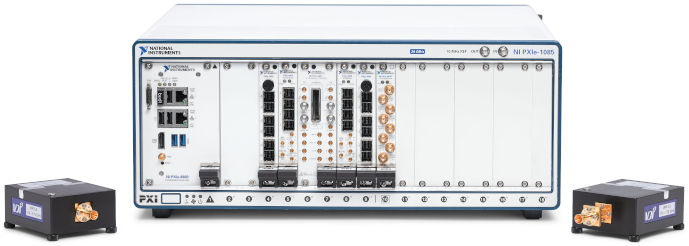
MTS has modular base-band and IF components that can be combined with programmable logic (FPGAs) to build complex RF transceiver – such as MIMO systems with digital signal processing capabilities. Adding VDI radio heads to this extends the range of MTS to higher frequencies – that NI is describing as the ‘sub-THz range’.
As the test bed is built using software-defined radios and programmable hardware, the same hardware can be customised to meet a wide range of research needs and applications, said NI. On top of this, users can re-use existing software reference designs for channel sounding or wireless communications protocols for research at higher frequencies.
“Researchers need access to sub THz test beds to prototype multiple wireless use cases,” said NI research director James Kimery. “These must be highly flexible but also offer cutting edge performance in order to explore the boundaries of wireless performance at these very high frequencies.”
The NI-VDI sub-THz test-bed provides up to 2GHz instantaneous bandwidth across 110-170GHz, and NI offers two software reference designs – one for channel sounding and one for a single carrier physical layer communications link.
The channel sounding reference design is intended for a single transmitter, single receiver configuration and enables users to take basic channel sounding measurements, such as channel impulse response, time of arrival and path loss.
The single carrier physical layer is designed for systems in SISO configurations up to 4×4 MIMO configurations with 2GHz of real-time bandwidth.
All signal processing, including coding, occurs in real-time on FPGAs added to the base MTS system. Total system throughput is dependent on the frame structure and the number of channels used.
“A typical expected throughput is 7.2Gbit/s/channel using the default frame structure,” claimed NI. “For each reference design, the software front panel gives users a real-time visualisation of system level performance.
6G?
NI’s argument for calling this 6G test gear is that development cycle of a typical wireless standard is ~10 years. As the commercial rollout of 5G begins in 2019, “wireless communications researchers are already investigating the technology and ideas that will serve as the foundation of 6G. The use of sub THz and THz frequencies has numerous applications for communications and is likely to be a major area of 6G research in the foreseeable future”.
“Now that 5G is becoming mainstream, communications research must move deeper into the millimeter and sub-millimeter wavebands,” added VDI COO Gerhard Schoenthal. “It seems D-Band is now the new E-Band.”