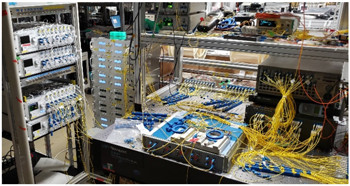
Low-loss MEMS optical switches were used, alongside three types (see table below) of next-generation spatial-division multiplexing (= multiple-core) fibres, routing signals with capacities from 10Tbit/s to 1Pbit/s.
The system was demonstrated in four scenarios to represent the building blocks of next-generation optical fibre networks:
- Optical switching of 1Pbit/s data
- Redundant configuration to support network failures or fibre breaks
- Branching of 1Pbit/s signals into different types of optical fibres with various capacities
- Management of lower-capacity (10Tbit/s) signals within the 1Pbit/s network
NICT collaborates with academia and industry, and has previously demonstrated petabit-class transmission in a single fibre (September 2015, September 2018) and the longest link using spatial division multiplexing amplifiers (March 2019).
Results were presented at 45th European Conference on Optical Communication (ECOC 2019) in Dublin as ‘Demonstration of a 1 Pb/s spatial channel network node’.
| Switch capacity |
Outline | Application | Fibres used |
|---|---|---|---|
| 1Pbit/s | Network Node with 1Pbit/s switching capacity | Metropolitan networks | 22 core fibre |
| 1Pbit/s | Redundant configuration to support fibre breaks | Metropolitan networks with possible network failures |
22 core fibre |
| 346Tbit/s 148Tbit/s |
Branching of signals to different types of optical fibres with various capacities |
Metropolitan Networks | 22 core fibre 7 core fibre 3 mode fibre |
| 10Tbit/s | Management of low-capacity signals to achieve high granularity |
Regional Networks | 22 core fibre |