Posted on 23rd April 2019 | Modified on 19th June 2025
Communications, Distribution, Industrial Electronics, Internet of Things, News, RF & Microwave
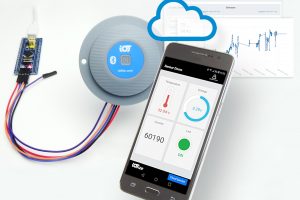
Developers and makers can take an existing microcontroller application that does not have wireless connectivity and, using just two GPIO pins, add it without modifying the original firmware, via IoTize‘s TapNLink products for Bluetooth and near field communications (NFC) products. The French start up company has signed a distribution agreement with Digi-Key to resell the wireless connectivity products for microcontroller-based embedded systems as ...
Posted on 18th April 2019 | Modified on 20th June 2025
Analogue / Linear / Mixed Signal ICs, Communications
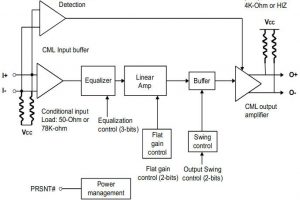
For long data cables, Diodes has introduced aPCIe 4.0 compliant equalising repeater for use between 2.5Gbit/s and 16Gbit/s. Called PI3EQX16904GL, and branded a ReDriver by the firm, the device supports four 100Ω differential current mode logic (CML) data I/Os, providing programmable linear equalisation, output swing, and gain to reduce inter-symbol interference over a variety of physical media. “It is the industry’s ...
Posted on 2nd April 2019 | Modified on 23rd June 2025
Analogue / Linear / Mixed Signal ICs, Communications, Connectors, Industrial Electronics
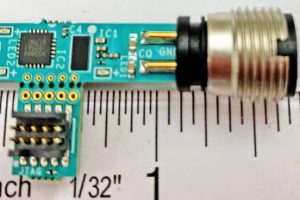
Intended to fit inside the end of industrial data cables, Maxim has unveiled a dual IO-Link transceiver that includes a dc-dc converter and surge – claiming it to be both the smallest and most power-efficient available. Called MAX2251, the buck regulator supplies up to 300mA of load current and has an adjustable output from 2.5V to 12V). Switching is a ...
Posted on 13th March 2019 | Modified on 25th June 2025
Communications, News, Testing
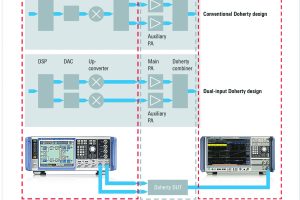
Doherty amplifiers can improve energy efficiency in 5G basestation transmitters, argue Gareth Lloyd and Patrick Agyapong. Doherty amplifiers, especially those with two independently driven inputs, promise significantly better energy efficiency in 5G basestation transmitters and similar applications. Power amplifiers in basestations constitute 30‑60% of the cost and 20‑60% of the energy consumption of the transmitter infrastructure, so optimal design is ...
Posted on 1st March 2019 | Modified on 29th May 2019
Communications
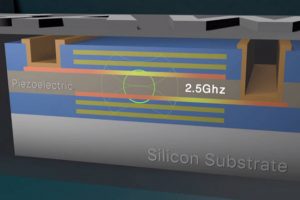
Texas Instruments has removed the need for external timing crystals by developing a technique for building high-grade thin film piezoelectric bulk acoustic wave (BAW) resonators within the metallisation of silicon chips, on a CMOS-compatible process that can be delivered in a standard, or even thin, QFN package. The crucial piezo film is sandwiched between two metal electrodes and several acoustic ...
Posted on 6th February 2019 | Modified on 13th June 2019
Business, Communications
The Government-sponsored Digital Catapult has set-up a laboratory dedicated to low-power wireless area networks at its London headquarters. Called the Future Networks Lab, it has been created with sponsorship and equipment from BT, IBM, PTC, Semtech, ServiceNow, Siemens and Texas Instruments. Technologies covered include LoRaWAN, SigFox, NB-IoT and LTE-M – and it also has a 5G node and access to the ...
Posted on 24th January 2019 | Modified on 25th June 2025
Communications, Research
Male Japanese tree frogs communicate with sound, using an internally orchestrated system that lets information get through while also permitting collective choruses and time to rest, according to researchers from Osaka University and University of Tsukuba, and borrowing the technique could reduce packet collisions and power consumption in data networks. The team listened to calling patterns between three frogs over ...
Posted on 22nd January 2019 | Modified on 22nd January 2019
Automotive Electronics, Communications, Digital Integrated Circuits, Industrial Electronics, Microprocessors
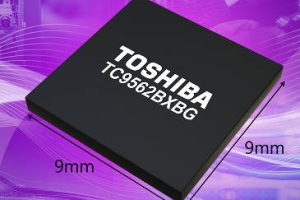
Toshiba has announced an automotive chip that can bridge between PCIe and two Ethernet standards: Ethernet AVB and Ethernet TSN, to connect central processors to telematics, infotainment and driver assistance systems, as well as sensors, at up to 1Gbit/s. Called TC9562XBG, “it’s not just a simple hardware-bridge between PCIe and Ethernet”, Toshiba Electronics Europe told Electronics Weekly. “Through the built-in ...
Posted on 2nd January 2019 | Modified on 25th June 2025
Communications, Research, University Electronics
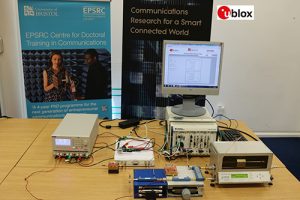
U-blox and University of Bristol have developed a tunable frequency-division duplexing RF front-end that combines passive and active self-interference cancellation. With the proof-of-concept demonstrator, an electrical-balance duplexer is used to passively cancel transmitter noise in the receive band, and an active canceller is employed to suppress self-interference in the transmit band. It has been characterised in duplex configurations working between ...
Posted on 11th December 2018 | Modified on 11th December 2018
Communications, Digital Integrated Circuits, Industrial Electronics, Internet of Things
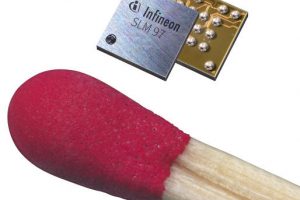
Infineon is claiming a first, with an industrial-grade embedded SIM (eSIM) in a 2.5 x 2.7mm wafer-level chip-scale package (WLCSP). It is aimed at machine-to-machine comms and IoT applications, for example vending machines, remote sensors and asset trackers. “Providing robust quality on a miniature footprint that works even under harshest conditions remains a challenge for silicon providers,” said the firm. Called ...