Posted on 24th January 2019 | Modified on 5th June 2019
Materials R&D, Power, Power Supplies
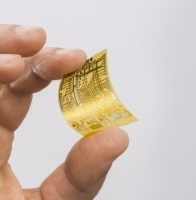
The quest for lightweight, compact batteries in power supplies and in electric vehicle is unrelenting, but researchers from the Fraunhofer Institute for Environmental, Safety and Energy Technology UMSICHT in Oberhausen, have developed a flexible and thin bipolar plate material for batteries which do not require sealing, which makes them vulnerable to leakage, and which can be welded to create large ...
Posted on 18th December 2018 | Modified on 18th December 2018
Materials R&D, News, Research, University Electronics
Researchers at the University of Manchester have identified dihydrolevogucosenone, a non toxic material which is less expensive than conventional conductive inks. It is a sustainable material that provides higher concentrations and conductivity compared with graphene ink and is lower in cost as it does not rely on metal nanoparticles for electrical conductivity in printed electronics. Printed conductive inks are being developed for transistors, sensors, antennae, ...
Posted on 31st July 2018 | Modified on 31st July 2018
Materials R&D, News, Research
Aiming to bridge the link between R&D into graphene’s properties and making its application into products on an industrial scale, the National Physical Laboratory (NPL) and the National Graphene Institute (NGI, pictured) at the University of Manchester, have set up a graphene characterisation service. Graphene is stronger than steel, yet is lightweight and flexible, it is electrically and thermally conductive ...
Posted on 12th June 2018 | Modified on 13th June 2018
Distribution, Materials R&D, Passives
Gateway opens a ferrite core gapping and machining centre at its Cheshire facility
Posted on 25th April 2018 | Modified on 30th April 2025
Displays, Materials R&D
Researchers developed a fast nanoscale oxide semiconductor-based TFT.
Posted on 9th January 2018 | Modified on 19th June 2025
Materials R&D, News
Researchers at the University of Manchester have developed graphene sensors embedded into RFIDs.
Posted on 6th February 2017 | Modified on 7th February 2017
Materials R&D, Military/Aerospace Electronics, News
Nano Dimension Technologies is to develop 3D printing of advanced ceramic materials in inkjet technology for use in the aerospace industry.
Posted on 21st September 2016 | Modified on 21st September 2016
Materials R&D, News
This furry caterpillar-like image could represent an important breakthrough in flexible semiconductors for displays and solar cells. It is a semiconductor with a double helix atomic structure, similar to that which is the basis of DNA.
A team from the Technical University of Munich (TUM) has discovered a double helix structure in an inorganic material. The material comprising tin, iodine ...
Posted on 7th July 2016 | Modified on 7th July 2016
Materials R&D, Power, Research
A simple thermal annealing process could make 3D printed heatsinks better than conventional heatsinks, claims the US Oak Ridge National Laboratory. 3D printing, a type of additive manufacturing, makes it possible to produce one-piece exchangers with complex internal structures optimised to efficiently dissipate heat, but the printed material does not conduct heat as well as extruded aluminium, for example. Researcher ...
Posted on 29th June 2016 | Modified on 7th July 2016
Device R&D, Internet of Things, Materials R&D, News, University Electronics
Intel has committed to invest $1.5m over the next three years in research in semiconductor materials, devices and photonics technologies at Tyndall National Institute, the Irish ICT research institute. Intel has been investing in research at the Cork-based institute since 2009. Bernie Capraro, Research Manager, Silicon Technology at Intel Ireland, said: “The standard of work from Tyndall researchers is top-class, from ...