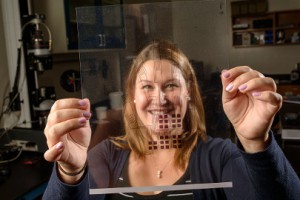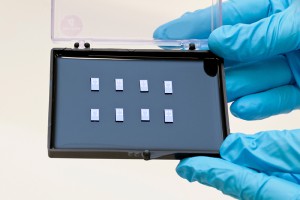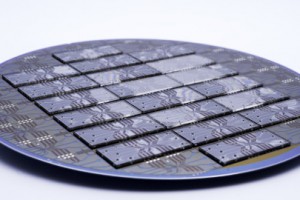
Southampton University, in its Optoelectronics Research Centre (ORC), is making its next-generation optical fibre available for purchase. Until now, access to the technology was limited to commercial or academic collaborations. The new optical fibre will be used in high-power lasers, high bandwidth communications and visible and infrared sensing. The Southampton University research centre is promoting the fibre technology by granting the wider ...
Materials R&D
Printed circuits can stretch the wearable boundaries
Electronic circuit boards that are stretchable may soon be used in robots and wearable smart clothing, say researchers at a US-based university. The aim of research at Purdue University is to inkjet-print liquid-metal alloys to create a new type of flexible electronic circuit. Elastic technologies could make possible a new class of pliable robots and stretchable garments that people might ...
Manchester firm bids to commercialise graphene devices
A Manchester-based company is moving graphene devices closer to commercial production using a technique known as chemical vapour deposition (CVD). The spin-out company from the University of Manchester, 2-DTech is producing polycrystalline graphene films, the base substrate for semiconductor devices, with commercially competitive defect density and high mobility. It said it can supply its CVD graphene products in a range of ...
Clothes that generate energy move a step closer
Research is getting closer to creating clothes and shoes which will self-generate energy to power wearable mobile devices. A report in the journal of the American Chemical Society (ACS Nano) describes a foldable nanopatterned material which can use human motion to generate energy. Energy is then stored in a battery or supercapacitor. Researchers in Korea and Australia used wearable triboelectric nanogenerators (TNGs) ...
Imperial researchers target printable graphene
Health sensors could one day be 3D-printed in graphene according to researchers at Imperial College, London. The team at Imperial has developed a method for printing miniature components from graphene, using a new graphene paste. Graphene is the new light and flexible semiconductor material first identified at the University of Manchester. One of the current challenges for engineers is to ...
Will 2015 be the key year for graphene?
Graphene has yet to move out of the research lab, but 2015 could be the year we see the first devices using the “new” semiconductor material. Imec has developed the industry’s first integrated graphene optical electro-absorption modulator (EAM) capable of 10Gbit/s modulation speed with a very low insertion loss and drive voltage. For chip-level optical interconnects, graphene will be used ...
Imec develops graphene optical modulator
Imec has developed the industry’s first integrated graphene optical electro-absorption modulator (EAM) capable of 10Gbit/s modulation speed which combines low insertion loss, low drive voltage, high thermal stability, broadband operation and compact footprint.
Malaysia firms develop graphene batteries for electric buses
Graphene NanoChem, the Malaysia-based graphene company, has announced a product development agreement with Sync R&D for graphene-enhanced lithium-ion batteries for use in electric buses As part of the Electric Bus 1 Malaysia programme, the Graphene NanoChem and Sync R&D will jointly develop a graphene-enhanced Li-on battery for a prototype electric shuttle bus in Malaysia designed and developed by Sync R&D. Graphene ...
Nanotech research makes colour displays “squid-like”
Research into colour display technology, which can be finely tuned, could provide clues about developing camouflaging metamaterials that can “see” colours and automatically blend into the background, as seen in nature with animals like squids. Scientists at Rice University’s Laboratory for Nanophotonics (LANP) in Houston, Texas set out in 2010 to create metamaterials capable of mimicking the camouflage abilities of ...
UK researchers claim to develop “super” graphene
Researchers from the University of Southampton’s Optoelectronics Research Centre (ORC) claim they have discovered a potential challenger to graphene.
Electronics Weekly