UK universities will be trialling high-resolution pollution monitoring system in cities across the country this summer. The idea is to provide real-time pollutant concentration maps, for which the project has developed three separate sensing devices.
Materials R&D
Electrowetting battery breakthrough
mPhase Technologies, which is commercialising a new battery technology based on electrowetting, has made a video demonstrating that a liquid electrolyte can be controlled on a man made surface.
Researches turn nanocrystals into electronic glue
Nanocrystalline get their behaviour not only from the materials they are made from, but their size and shape. Hence their opto-electronic properties can be tuned by making the crystals bigger or smaller.
Detrimental voids discovered in Pb-free solder joints – University of Leicester
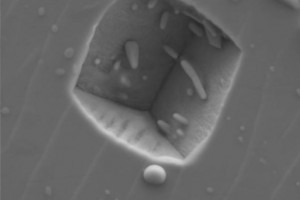
Detrimental voids have been discovered in Pb-free solder joints, according to a University of Leicester researcher. Post-graduate Sergey Belyakov, is taking a deep look at Pb-free soldering for the University's materials research group.
Graphene could out-perform copper for on-chip interconnects
Graphene could out-perform copper as on-chip interconnects, claims the Georgia Institute of Technology.
Durham produces all-organic memory-transistor
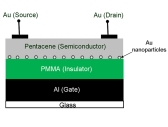
The University of Durham has produced an all-organic memory-transistor. "It is an evolution of silicon flash memory," Professor Mike Petty told Electronics Weekly. "Our step has been making both the semiconductor and the insulator organic."
Carbon nanotubes promise billion year memory storage
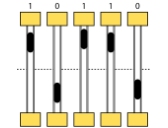
"We've developed a mechanism for digital memory storage that consists of a crystalline iron nanoparticle shuttle enclosed within the hollow of a multiwalled carbon nanotube," said project leader Alex Zettl.
Nanoscale electric current generator uses rotating atoms
Micro-miniature current generators are the subject of research being carried out at the University of Liverpool in partnership with a university in China
Scientist uncover key mechanism in magnetic cooling crystals
"This is an exciting discovery because it means we may one day be able to tailor-make a material from the bottom up, starting with the microstructure, so it ticks all the boxes required to run a magnetic fridge," says Professor Lesley Cohen.
UK firm starts research into lasers for high speed internet
It is anticipated that the research could one day lead to laser diode-based optical communictaions systems capable of supporting internet access technology with speeds up to 10Gbit/s
Electronics Weekly