The organisation has distributed £340,000 across seven space communications and technology projects. Being developed in the North East, the projects range from tracking space debris to developing ultra-reliable communications systems.
North East Space projects
The seven North East Space projects include three involving Northumbria University. First, SkyScan: Regional SSA Enhancement through Astronomical Imaging for space object tracking. Secondly, GOATS (Gallium Oxide Antimony Tri-Selenide), a broadband photodetector for resilient space communications. And thirdly, the MASER-Link project, the Reconfigurable MASER-Based Microwave Communications Platform, which also involves radio frequency experts Filtronic.
And Durham University, another university participating in NESCA, is also involved with three projects. First, the Retro-modulated Free-space Link using Electro-optic Communications Technology. Second, the prototype development of an Optical PAT System for Low-Latency In-Space Opportunities. And finally, Geopolitical Analysis in Space Domain Awareness. This will be working in partnership with aXenic, AmbaSat Ltd and 3S Northumbria.
The remaining project of the seven selected is led by Newcastle University. This is Quantum Light Source for Ultra-Secure Satellite Links, led by Dr Aleksey Kozikov in partnership with Astrogate Labs UK Limited.
NESAC
Launched a year ago, NESCA is a £2.6 million, four-year programme funded by the Engineering and Physical Sciences Research Council (EPSRC).
It is a collaboration between Northumbria, Durham, and Newcastle universities, the North East Combined Authority, Space North East England, and the North East Space Leadership Group. There are also 14 industry partners as well, including Lenovo and Logicalis.
Note that further funding rounds will occur through the programme. For example, round two is now open, closing on 2 February 2026.
Real-world impact
The NESCA project lead is Professor Vincent Barrioz, from Northumbria University’s School of Engineering, Physics and Mathematics:
“These first awards demonstrate NESCA’s commitment to translating world-class research into real-world impact,” he commented.
“We’re particularly pleased to see such strong leadership from Early Career Researchers and the level of industry engagement across all projects. This funding will accelerate innovation in space communications whilst creating high-skilled jobs and driving economic growth in the North East.”
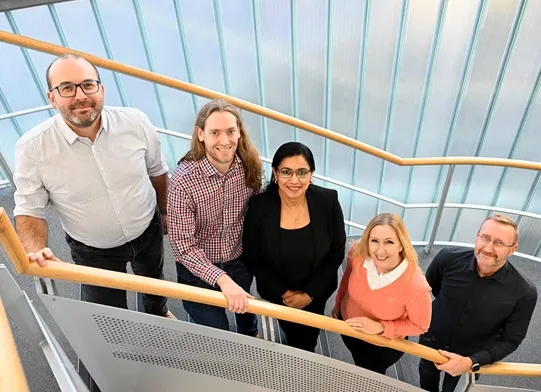
Image: Northumbria University (left to right) NESCA project lead Professor Vincent Barrioz, Dr Matthew Townson, Dr Juna Sathian, Impact Accelerator Account Manager Alisha Peart and Dr Stephen Campbell
See also: Northumbria University builds and tests first ALIGN CubeSats