“When immersed in fluid and connected to electrodes, solid-state nanopores allow individual molecules to pass through, generating electrical signals that can be analysed in real time,” explained Imec. “Because the pore size can be easily adjusted, they offer a wide range of applications, from virus identification to DNA and protein analysis.”
Biological nanopores, formed by proteins in lipid membranes, are already used commercially for such purposes, but are not natural bed fellows with electronics.
Imec, a specialist in lithography-based integration, aims to build monolithic ICs that contain the pores, suitable electrodes and the necessary fluid delivery system.
In the proof-of-concept, it defined 4 x 4mm chips across a one wafer, each of which is etched to leave a ~30nm thick 50 x 200μm SiN membrane, into which the pores are formed.
Wafer-bonding adds a second wafer with pre-defined micro-fluidics for electrolyte and sample delivery.
To be useful, such nano-pores have to be dimensioned to suit the task in hand. What sort of accuracy has been achieved so far?
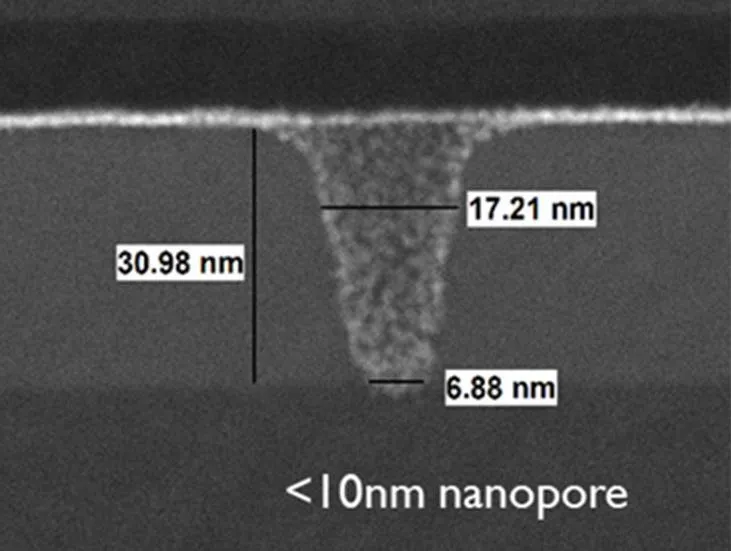
“We measure the top diameter post-etch, which is 16±2nm,” Imec told Electronics Weekly. “The etch is conical and hence this leads to a pore size of 10±2nm.”
Hydrophobic surface behaviour can prevent aqueous water-based electrolytes from entering nano-pores. According to Imec, aqueous tests “confirmed excellent wetting behaviour”.
Detection is based on a applying a potential difference between the membrane faces, that causes measurable ion current to flow through the pores.
“We look at parameters such as the electric resistance, linearity of the current-voltage characteristics, hysteresis and the frequency dependent noise spectra to evaluate the quality of the nanopore device,” said Imec.
In the electrolyte, a DNA molecule, for example, will be dragged through the pore as the molecule’s inherent negative charge interacts with applied electric field.
“That results in a partial blockage of the pore, which is reflected in a transient dip in the ion current – the signal-to-noise ratio of that current drop is being used as the relevant metric”, the lab said.
While the report at IEDM (the IEEE International Electron Devices Meeting, held in San Francisco) described the creation and used of the nano-pores, electrodes and fluidics, interested parties are going to have to wait until mid-February 2026 for ISSCC (the IEEE International Solid-State Circuits Conference – also in San Francisco) to find out how the read-out electronics is being integrated, where Imec is due to present the paper ‘A 256-channel event-driven readout for solid-state nanopore single-molecule sensing with 193pArms noise in a 1MHz bandwidth’.