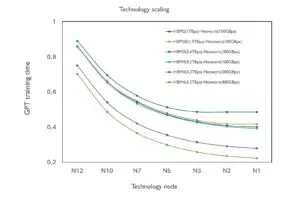
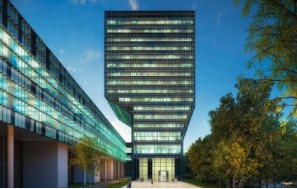
Imec has launched imec.kelis, an analytical performance modelling tool designed to revolutionise the design and optimisation of AI datacentres. Early adopters are already experimenting with the tool. The AI datacentre landscape is undergoing rapid transformation. As workloads scale to trillions of parameters and energy demands surge, system architects face mounting pressure to balance performance with sustainability and cost. Traditional simulation ...
Aalto University has demonstrated Tensor calculations using light. “Tensor operations are the kind of arithmetic that form the backbone of nearly all modern technologies, especially artificial intelligence,” according to the university. “While humans and classical computers must perform these operations step by step, light can do them all at once.” Shanghai Jiao Tong University in Shanghai and the Chinese Academy ...
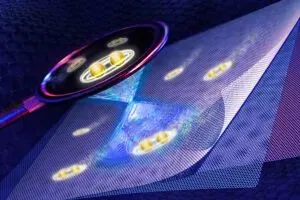
MIT physicists have observed unconventional superconductivity in “magic-angle” twisted tri-layer graphene (MATTG) — a material that is made by stacking three atomically-thin sheets of graphene at a specific angle, or twist, that then allows exotic properties to emerge. MATTG has shown indirect hints of unconventional superconductivity and other strange electronic behaviour in the past. The new discovery offers the most ...
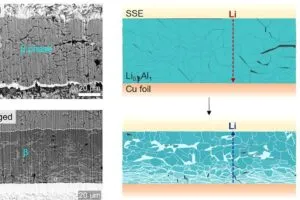
University of California San Diego engineers have better understood aluminium-lithium metal as a negative electrodes for solid-state batteries. They studied how lithium ions move through two phases of the material: lithium-rich ‘beta’ and lithium-poor ‘alpha’. Increasing levels of beta phase provided pathways for lithium ion diffuse “up to ten billion times faster than through the alpha phase”, according to the ...
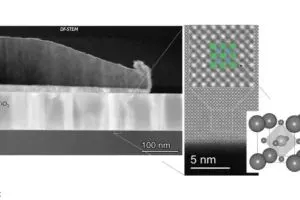
At 4 degrees Kelvin, most electro-optic materials falter but imec has now engineered thin-film strontium titanate (SrTiO₃) that delivers record electro-optic performance with low optical loss, pointing to shorter, faster building blocks for quantum devices. Quantum computers and detectors run at temperatures close to absolute zero. In these extreme conditions, even the best room‑temperature materials struggle to control light efficiently. ...
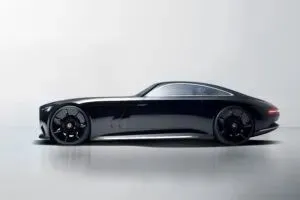
Mercedes-Benz has unveiled this Vision Iconic concept car at this month’s Shanghai Fashion Week. It has steer-by-wire technology, a PV active coating and an incongruously square front grill at the front of a sleek, sportscar body. The Vision Iconic is a long-bodied vehicle with rear-wheel drive. It uses steer-by-wire technology to send steering inputs electrically via control units and actuators ...
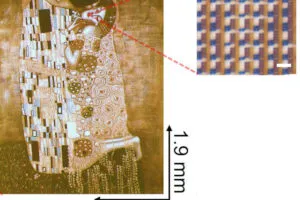
A team from Sweden has created a micro display with the smallest ever pixels, it claims. It is a reflective display that uses sub-wavelength structures that act as meta-materials to create a colour image. Chalmers University of Technology, the University of Gothenburg and Uppsala University collaborated on the proof-of-concept device, which uses a three-level geometric hierarchy to create CMY pixels. ...
Imec CEO Luc Van den hove (pictured), Baden-Württemberg’s Minister-President Winfried Kretschmann and Minister of Economic Affairs, Labour and Tourism Dr Nicole Hoffmeister-Kraut have officially inaugurated imec’s new office at the IPAI campus in Heilbronn. The Heilbronn hub is dedicated to driving the transition toward chiplet-based architectures in the automotive industry – in close partnership with German industry and research partners. ...
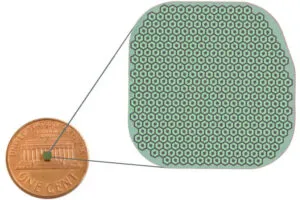
Sufficient vision for reading has been restored to volunteers with ‘dry age-related macular degeneration’ in a trial of an electronic eye implant. The implant, which works with custom AR glasses and needs no direct electrical connection, is from Californian company Science. It measures 2 x 2mm and 30μm thick, contains 378 closely-packed hexagonal pixels each 100μm across, and is inserted ...
Do you have to be an idealist to invest in deep-tech start-ups? asks Imec. You might think so. Putting your money in deep-tech is a surefire way to have a positive impact on society. By supporting deep-tech ventures, you pave the way for fundamental scientific and technological breakthroughs to address some of humanity’s biggest challenges in domains like energy, health, ...