Researchers at Virginia Tech have combined liquid metal and a heat-activated adhesive to create an electrically conductive patch that bonds to fabric when heated with a hot iron. “E-textiles and wearable electronics can enable diverse applications from health care and environmental monitoring to robotics and human-machine interfaces,” said Virginia Tech engineer Michael Bartlett. “Our work advances this by creating iron-on ...
fabric
Flexible piezo-harvester sticks well to fabric
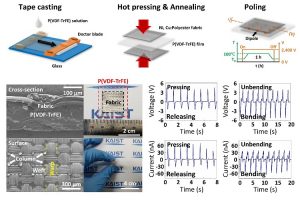
An easily applied patch on fabric could be used to power wearables, according to Korean research lab KAIST. It is based on the ferroelectric polymer poly(vinylidene fluoride-co-trifluoroethylene), built into a heterostructure with two conductive fabrics (diagram right), which can then be applied to fabric by a similar hot-pressing process to that used to attach graphics to T-shirts – taking two ...
High-performance fabric sensors survive washing machine
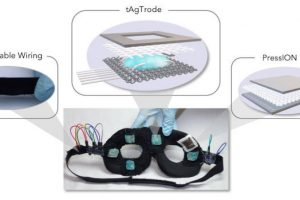
Re-usable flexible medical skin electrodes have been built by combining fabric and chemical engineering at the University of Massachusetts Amherst. Technical performance is similar to commercial wet gel electrodes, while convenience is comparable to dry electrodes – which are easy to use but generally provide inferior signals to wet electrodes. Four of the electrodes have been built into a mask, and ...
PICMG gets embedded systems up to speed
Looking at the market for open specification equipment, a trend emerges – the customer is demanding higher performance. This drive relates not only to the performance of the silicon, but to the interconnect, the fabric that links these blades and modules together. The requirement to develop higher speed interconnects has put designers under increasing pressure to create solutions that meet ...
Laird Technologies 3D’s interactive design tool
Virtual Tool enables design engineers to download 2D drawings and 3D models in all conventional CAD formats, to configure Fabric-over-Foam EMI shielding gaskets
FPGA maker starts to trade frequency and power
Constraints imposed by the chip industry having reached a power/density ceiling have persuaded Altera to develop a programmable silicon fabric at the 65nm process node where customers can select the frequency/power combination they want
US chip trio warn of ‘worsening’ Q2…
STMicroelectronics is nurturing a product which could double the size of the company, according to an industry analyst. The product, unveiled last October, is GOSPL (generalised open source programming logic) which provides a reconfigurable silicon fabric to be used in ASSPs, Asics, or SoCs, along with a million lines of source code, a complete EDA toolset, and synthesis, placement, routing ...
Electronics Weekly