
Micro:bit launch at the BBC
Around 1 million of the devices will be given to all Year 7 children (11/12 year-olds) in the UK by late October (an online simulator, to help teachers get to grips with it, will be available in September).
See also: Picture Gallery: BBC Micro:bit launches in London
See also: Video: Hands on with the BBC Micro-Bit user interface
Legacy
Deliberately invoking the legacy of the BBC Micro of the early 1980s, the device is aiming to change the emphasis from consumption to creation when it comes to young people and technology.
As well as open sourcing the technology behind the Micro:bit, the BBC is also setting up a not-for-profit company to license the device and make it commercially available to everyone who is interested.
Citing the original BBC Micro, Tony Hall, director-general of the BBC, said at the launch: “We want to take the legacy and reinvent it for our age, so that future generations can say ‘this inspired me'”.
The BBC Micro was part of a BBC Computer Literacy Project and it was designed and built by Acorn Computer, which developed the ARM (Acorn RISC Machine) architecture that is so prevalent today in mobile devices, and at the heart of the Internet of Things concept.
From Acorns to IoT
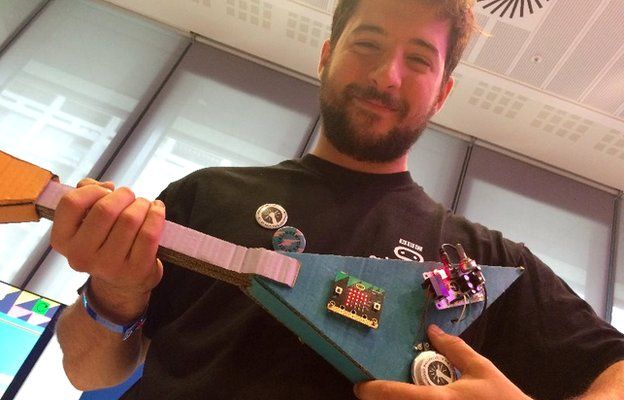
Technology Will Save Us – Micro:bit guitar
The Micro:bit collaboration actually involves a wide range of other companies and organisations, such as Samsung, Nordic Semiconductor, Farnell element14, Bluetooth SIG, Technology Will save Us, Barclays Bank, Microsoft, Lancaster University, Wellcome Trust and more.
The spec? Tongue in cheek, the Head of BBC Learning, Sinead Rocks, said that the device was faster and smaller than the BBC Micro (18x faster, 70x smaller and 617x lighter, to be precise). It runs on a 32-bit ARM Cortex-M0, the smallest ARM processor available.
Actually, there are two on board: the NRF51822_QFN48, made by Nordic Semiconductor, which both controls the board and enables Bluetooth Smart comms, and a Freescale Kinetis KL26 MCU, the MKL26Z128VFM4, which serves as the USB controller.
She described it as having 25 programmable LEDs, two physical buttons, and an accelerometer and magnetometer (compass) for motion and positioning information. And its Bluetooth Smart capable.
Lancaster University
The operating system has been developed by Lancaster University, led by Dr. Joe Finney, and uses ARM mbed technology for interfacing to the hardware.
There are two code editing interfaces, both developed by Microsoft: the Block Editor for younger users, and the Touch Development Environment, for older users. You can code in Java, C++, Python and Block.
There are five I/O rings to connect the Micro Bit to other devices or sensors using crocodile clips or 4mm banana plugs, to send commands to and from the rings, to power devices like robots and motors.
The 4cm by 5cm device is powered via a USB cable, or otherwise via a battery-pack accessory

BBC Micro:bit board layout
Rocks said she hoped it would get kids “creative with coding” and described it as “biggest educational initiative the BBC has ever led”:
“The BBC Micro:bit is all about young people learning to express themselves digitally. As the Micro:bit is able to connect to everything from mobile phones to plant pots and Raspberry Pis, this could be for the internet-of-things what the BBC Micro was to the British gaming industry.”
Speaking at the event, Richard Curtin, global director of strategic alliance at Farnell element14 – who will managing the manufacturing of the devices – welcomed the initiative: “The electronics industry relies on new engineers to come through and the BBC’s efforts will have a strong effect.”
ARM, Lancaster, Freescale, Samsung…
How do the various partners fit together?
The BBC Micro:bit was created using the ARM mbed hardware and software development kits and compiler services. other companies, such as Microsoft and Lancaster University’s operating system all interface into the mbed technology.

A new way to take selfies with the BBC Micro:bit
For example, it enables Lancaster University’s Micro:bit runtime system and the Microsoft programming interface to sit on top of mbed’s cloud compiler service. This converts users’ programmes into Micro:bit code. You ‘flash’ these files onto the device over USB or BLE for the board to run.
Freescale is responsible for supplying the sensor technology within the device: the accelerometer, the magnetometer, and the Micro-USB controller (the Kinetis KL26 MCU) for the Micro-USB port.
Sensors
The latter allows users to connect the Micro:bit to their computers. And they will appear in a similar way to a USB drive. Users can then drag their compiled code file onto the Micro:bit and run it.
Freescale has also provided the motion sensors that enable the Micro:bit to react to movement and the direction it’s facing. The idea, of course, is these will allow children to create applications based on position. And whether they shake, turn or tilt their Micro:bit…
Mobility
On the mobile side of things, Samsung is helping smartphones and tablets communicate with the device. By enabling the Micro:bit to tap into the functions of everyday digital devices – there is a new Bluetooth Smart profile especially for the Micro-Bit from the Bluetooth SIG (an official “BBC micro:bit product champion”) – it opens up more possibilities for imaginative uses. For example, selfies. Kids could code their Micro:bit to launch their phone camera remotely to take a picture at the push of a Micro:bit button. Or they could code their device to act as a remote control to play music on their phone. Basically opening up the functionality of their phones to exchange data and commands. And also, enabling users to play games and share their creations.
Samsung will also publish an app that will support the Micro:bit coding environment on (Android) mobile devices, supporting on-the-go programming. Samsung says it “will help introduce the Internet of Things and the future of connected technologies into the classroom”.
BBC

Table-top displays showcasing Micro:bit projects
In the BBC’s own words:
- ARM – providing mbed hardware, software development kits and compiler services
- Barclays – supporting overall product delivery and outreach activities
- element14 – sourcing components and managing the manufacturing
- Freescale – supplying the sensors and USB controllers
- Lancaster University – creating and writing the micro:bit runtime
- Microsoft – providing the TouchDevelop web-based programming tools and hosting service as well as teacher-training materials
- Nordic Semiconductor – supplying the main processor and enabled Bluetooth Smart
- Samsung – connecting the BBC micro:bit to phones and tablets, and developing the Android app
- ScienceScope – distributing to schools and developing the iOS app
- Technology Will Save Us – designing the shape, look and feel of the device
- The Wellcome Trust – providing learning opportunities for teachers and schools
Read more about the Micro:bit on the BBC »
Why not simply work with the Raspberry Pi Foundation? The BBC says the simpler Micro:bit will help younger children to start learning how computers work. It will also be a springboard for relatively more advanced devices like the Raspberry Pi and Arduino.
Hands on demo of Micro:bit
Dara Ó Briain was host of the launch event. And coincidentally he pops up in a video I was recoding of the BBC Micro:bit coding interface:
Note that The Micro:bit no longer contains a slot for a watch battery, which was a feature in the prototype.