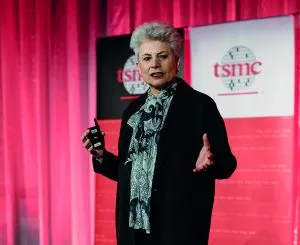
 Maria has worked in the semiconductor industry since 1984 and has built an impressive CV. She was president TSMC Europe until 2023, having previously held senior vice-president roles in NXP Semiconductors and Intel. Today she is corporate director CEVA, IQE and Sequans Communications and joined the KD board in July 2025.
As chair of the Chips Act 2.0 Industry Advisory Board she took part in an EU Chips Act 2.0 webinar in October, discussing the impact of the Act on the global semiconductor industry. “I think the key challenge for European semiconductor growth is the fragmentation of the EU that avoids scale and simplification of procedures and programs. Becoming ONE EU instead of 27 would be paramount to EU success,” she says.
Chips Act 2.0
“The opportunity would be from two angles: strengthen our strengths (automotive, industrial) and foster innovation based [on] and around AI.” She believes these challenges and opportunities are being addressed by the Chips Act 2.0, which is the next phase of Europe’s semiconductor strategy.
What will drive the next stage of Europe’s semiconductor innovation and growth? As director of CEVA IP, a silicon and software IP specialist, she thinks the IoT, after the consolidation of mobile, is a key growth driver for connectivity, together with embedded AI capabilities for edge AI.
Another director role is with low-power cellular IoT chip company Sequans. Again, Maria sees edge AI as a key growth driver for 5G and 6G and LTE-M developments, where it avoids latency and improves privacy.
“LTE-M is an effective solution for IoT devices needing long battery life, while 5G offers high speed/low latency for enhanced mobile broadband and advanced IoT… and 6G promises revolutionary performance for immersive experiences and advanced AI.”
Maria is also a director at IQE, the British semiconductor company that completed a £1.1m UltraRAM industrialisation project in July 2025.
“Moore´s law has evolved towards heterogenous advanced packaging in order to overcome the physical limits of the transistor miniaturisation,” she says.
The company is also proving the manufacture of compound semiconductors “that is the first step to a commercial production of packaged UltraRAM chips”.
Packaging
Her latest post is with KD. The Spanish mixed signal semiconductor company manufactures transceivers and asics for optical fibre networks.
It has attracted a lot of interest for developing the first semiconductor packaging and testing factory in Spain. It has designed packaging that meets all the requirements of the automotive industry and will initially produce transceiver ICs for vehicles before working towards mass production for optical transceivers.
Packaging represents a high percentage of the cost of transceivers and automating the assembly lines is the only way to produce in mass volumes and remain competitive against Asian manufacturers, says Maria. The Tres Cantos factory, just north of Madrid, will serve as an example of resilience for other similar initiatives in Europe, she adds.
Mentors make a difference
Maria was one of two women in a cohort of 1,000 when studying engineering and she graduated as a telecommunication engineer from the Politecnique of Madrid. She was fortunate, she says, to be one of the very few engineers designing with Intel MCUs and MPUs in 1978 and joined Intel Germany as a field applications engineer. She remained there for 19 years, rising to vice-president and EMEA general manger, joined NXP Semiconductors as a senior vice-president and was appointed president of TSMC Europe, based in Amsterdam, in 2007.
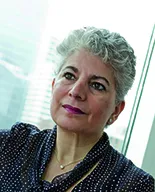 She believes that the industry needs to attract more young talent. “We need to seduce the youth. We need more talent.” Her advice to anyone considering a career in electronics is: “Be ready to embrace risk, moving is key to opening your mind.”
She also advises choosing the right partner. “I owe my career to my husband, who has followed me to four countries, [through] 19 international moves!”
There is one thing she would change and as someone who speaks Spanish, French and English, it is fitting that it pertains to the language of our industry. “Semiconductors is an awful word…. Difficult to explain… ” Instead, she would encourage us to “just say semi”. It is also quite fitting, as the suggestion can be a metaphor for her outlook; finding a practical solution to remove barriers and make the industry accessible to all.