Posted on 21st January 2026 | Modified on 26th January 2026
Materials R&D, News, Recycling, University Electronics, WEEE Directive
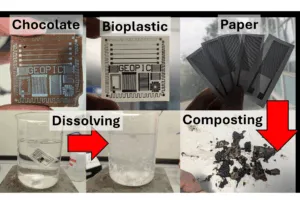
Circuit boards that are almost entirely biodegradable have been developed by researchers at the University of Glasgow, electroplating circuitry onto compostable substrates – including chocolate. Instead of conventional circuit boards that are sent to landfill, adding to the problem of electronic waste, the team has developed a method to print zinc-based electronic circuits on environmentally-friendly surfaces such as paper and ...
Posted on 2nd November 2011 | Modified on 6th March 2025
WEEE Directive
The European Parliament’s Environment Committee voted by 52 votes to 1, with 5 abstentions on its second reading recommendation on the Waste Electrical and Electronic Equipment (WEEE) Directive that aims to make existing rules even tougher. However, the crystal ball suggests that the second reading is unlikely to receive widespread approval and, as with the RoHS Recast, a series of ...
Posted on 14th April 2010 | Modified on 14th April 2010
WEEE Directive
Allowing for an 18 month transposition period the recast of the Waste Electrical and Electronic Equipment Directive could become UK law by the end of 2012 although there is a possibility that it may drift into 2013. A draft report was published in February. Orgalime, the European Federation of major trade associations has responded and the reply includes input from ...
Posted on 3rd February 2010 | Modified on 3rd February 2010
Recycling, WEEE Directive
A study published by the European Commission recommends the creation of a dedicated European body to oversee the implementation and enforcement of European Union waste law. This forms part of a series of steps being taken by the EC to improve waste management and ensure it meets the requirements set by EU legislation to protect human health and the environment.
Posted on 22nd September 2009 | Modified on 22nd September 2009
Recycling, WEEE Directive
The WEEE directive requires 10 categories of electrical equipment to be collected, treated, recycled and disposed of when it reaches end of life. The directive sets targets for the percentages of materials that must be recovered and includes a list (in Annex II) of parts that have to be removed and then recycled separately. The Directive also includes a requirement ...
Posted on 22nd February 2008 | Modified on 22nd February 2008
WEEE Directive
So finally the German courts decided that a high-tech sports shoe does not fall within scope of the WEEE (Waste Electrical and Electronic Equipment) Directive.
Posted on 14th February 2008 | Modified on 14th February 2008
WEEE Directive
The dismantling time for products can vary enormously depending on whether or not they are designed for easy recycling.
Posted on 12th July 2007 | Modified on 12th July 2007
WEEE Directive
The EU WEEE (Waste Electrical & Electronic Equipment) Directive requires 10 categories of electrical and electronic equipment to be collected, treated, recycled and disposed of when it reaches end-of-life. The directive sets targets for the percentages of materials that must be recovered and includes a list of parts that have to be removed and then recycled separately. The Directive also ...
Posted on 2nd July 2007 | Modified on 2nd July 2007
WEEE Directive
To be honest WEEE is a pretty complicated directive. Unlike RoHS, this is categorised as an Article 175 directive meaning that the interpretation, and implementation, may well differ across EU Member States.
Posted on 19th June 2007 | Modified on 19th June 2007
WEEE Directive
After multiple false starts, as of July 1st, the new Waste Electrical and Electronic Equipment (WEEE) regulations will ensure that major producers, rebranders and importers of household electrical and electronic equipment (EEE) are signed up to pay for the responsible disposal and recycling of their goods.