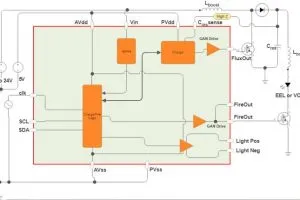
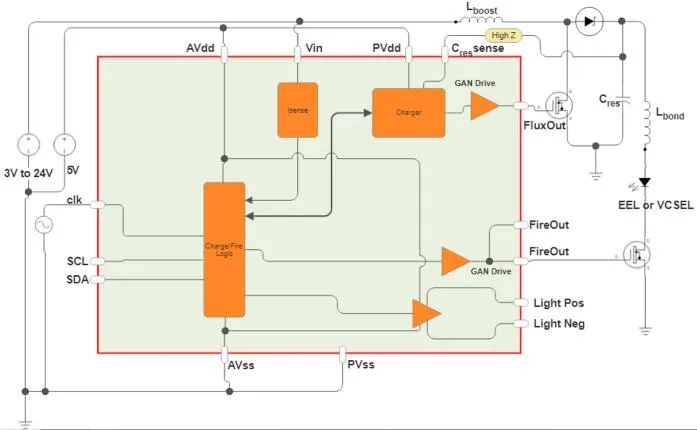
Specifically, there is the SL2001 (above) and SL2002, and both have their own evaluation kits (SL2001 EVK, SL2002 EVK).
 The company highlights they combine resonant capacitor charging and high-current laser diode firing on a single device. This eliminates multiple external discrete components and inefficient conversion phases.
Silanna writes:
“For example, using the SL2001 with a 400 W quad edge-emitting laser (EEL) module can reduce a laser system’s footprint by 80% (from 400 mm2 to 80 mm2).”
“Both the SL2001 and SL2002 are housed in a 14-pin 3.5 mm2 package. They offer a Vin to resonant capacitor charging efficiency of up to 85% [for use] with both EEL and VCSELs (vertical-cavity surface-emitting lasers).”
SL2001
The SL2001, created for automotive-grade LiDAR, delivers sub-2 ns FWHM laser pulses. And there is a peak power output of 1000 W when running from a 3 to 24 V supply.
SL2002
The SL2002 is for handheld and battery-operated systems using a 2.8 to 5.5 V supply to deliver a 100 W pulse with a 1 MHz pulse repetition frequency.
The ICs were first announced in May last year.
Laser firing
“There is a huge need to integrate laser-based measurement into an array of applications, from automotive LiDAR to sports, hunting, industrial, logistics and consumer systems,” said Ahsan Zaman, Product Marketing Director at Silanna Semiconductor.
“In all these applications, engineers need to reduce size, power loss, system complexity and system cost. We’ve had an incredible response to previews, so we’re delighted to have moved into full production.”
More information on the laser firing ICs is on the Silanna website.