It is a modified form of the equally quietly released REF80, which is a temperature-controlled buried Zener reference with 0.05ppm/°C drift and better than 1ppm stability. Its output is around 7.6V, and it is specified over 0 to +70°C.
After 1,000 hours (and up to 5,000h), stability improves to 0.3ppm.
This takes it close to Linear Tech’s (latterly ADI’s) legendary ~7V LTZ1000 reference, which is also an oven-ed buried Zener design with 0.05ppm/°C drift, specified over a mighty -55 to +125°C, and long-term stability of 2µV/√kHr.
ADI’s own stab at a LTZ1000 redesign, the ~6.62V ADR1000, scores 0.5ppm/year typical long-term drift after initial 3,000 hours, and better than 0.2ppm/°C. It is specified over -40 to +125°C.
A note here: qualifying such references is a science in itself, so the headline specs above are unlikely to be exact apples-to-apples comparisons.
In all the cases detailed so far, the priority is an unwavering output voltage, with the exact magnitude of this voltage down the priority list and depending on device-to-device production variation.
ADR1000 scores better on output magnitude accuracy than the LTZ1000: 6.62V ±50ppm initial accuracy compared with 7V +300mV -200mV.
TI’s REF80 7.6V is described as ±50mV, and there is a histogram in the data sheet that indicates -25 to -35mV initial accuracy, if electronics weekly is reading it correctly.
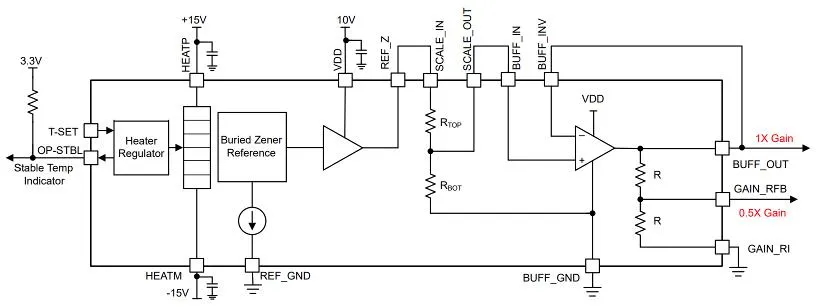
The new REF81 bucks this Zener-dependent output voltage by adding a buffer and a precision gain amplifier to the REF80, inside the same temperature-controlled 9 x 9mm hermetically sealed ceramic surface-mount package.
Like the REF80, it is specified over 0 to +70°C.
REF81 has the un-buffered REF80-like ~7.6V output (tolerance un-specified in the October 2025 advance information data sheet), but the IC is also going to offer a choice of:
- 2.5V, 4.096Vor 5V (all ±0.05%)
- 5V, 8.192V or 10V (all ±0.1%)
“The integration of control loop, precision resistances and buffer eliminates need of external precision components,” according to the data sheet.
These two ranges are the result of two pad-selected operating modes, variously described as ‘x1’ and ‘x2’, or ‘0.5x’ and ‘1x’, in the advanced data sheet.
Electronics Weekly has asked TI how the three voltages in each of the two modes are selected – although judging by this example design, which calls for a REF8150, there are three separate ICs, and the design example uses the 5V/10V version.
The 7.6V output continues to be specified as 0.05ppm/°C, and 0.3ppm (1,000 to 5,000h), while the temperature drift of the buffered outputs has yet to be announced.
Find the REF81 advanced data sheet here, and there is an app note that mentions REF80 and REF81.