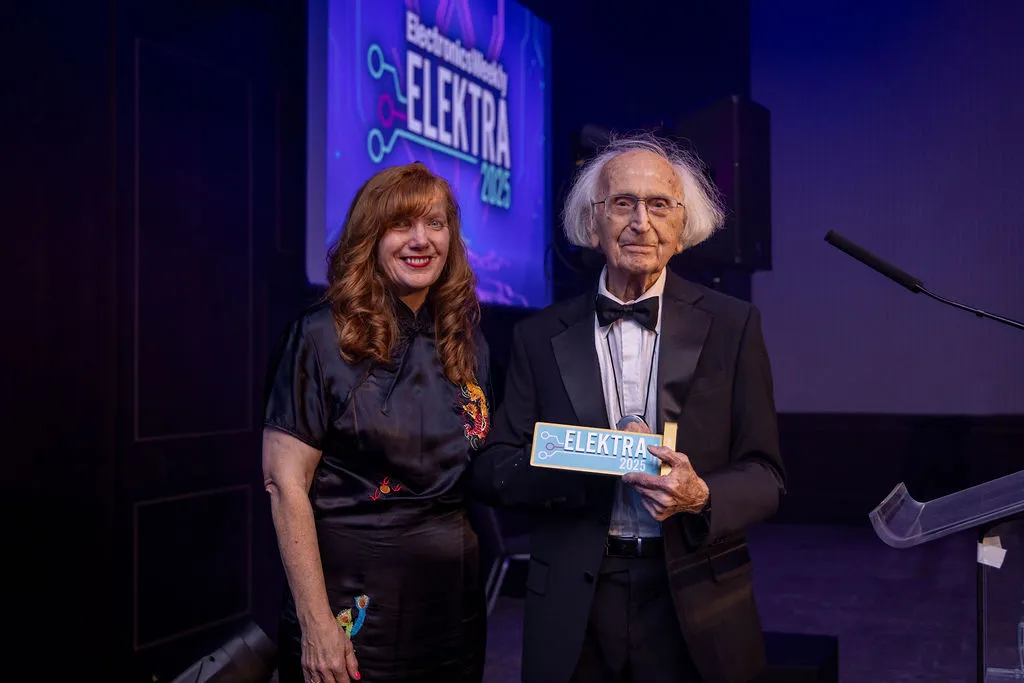
Professor Hilsum was recognised for his lengthy career achievements and his contribution to the electronics industry over a career spanning six decades. His work at the MoD after the second World War produced commercial applications for Gallium Arsenide and he also created the UK’s first semiconductor laser. He developed the theory of the Gunn diode but he may be best known for his research which became the basis for LCD technology.
His work, over 40 years ago, introduced III-V semiconductors, which has led to advances in LEDs and micro-LEDs, lasers, photodetectors and high-frequency electronics in automotive and aerospace systems.
He is a former president of the Institute of Physics and today is part-time chief science officer at Infi-Tex, working on force-sensing fabrics for healthcare, robotics and wearable applications. He maintains his interest in academia as visiting professor of physics at University College London and delivers an annual lecture on intellectual property at Imperial College London’s Life Sciences school.
Professor Hilsum celebrated his 100th birthday earlier this year and, accepting the award, joked that he probably qualifies as the title’s oldest reader.
He modestly recapped his career, saying that his best talent was “to get good people to work with me”. Recalling his work at the Royal Radar Establishment (RRE) in Malvern, in the late sixties, he also referenced developing the first prototype for a “mini radar”, the size of a cigarette packet. He jokingly apologised for its subsequent use in portable police radars – the scourge of speeding motorists.