“Our Universal Processor does it all – CPU, GPU, DSP, FPGA – in one chip, one architecture,” says CEO Hyun Shin Cho.
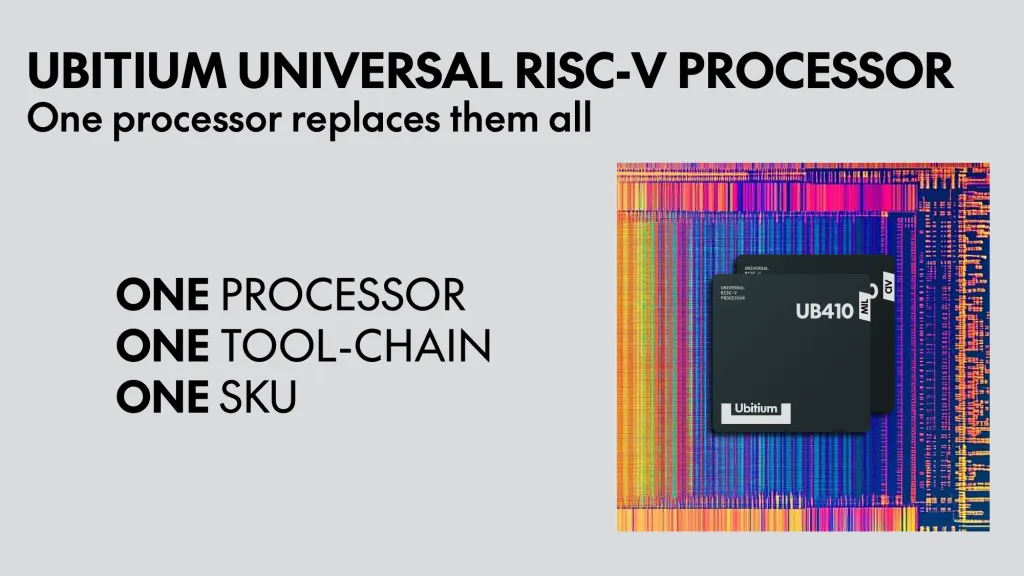
Ubitium believes that the wide variety of embedded processors can be replaced by a universal processor.
Built on Samsung Foundry’s 8nm process using RISC-V, the Ubitium processor runs Linux and RTOS simultaneously, handles radar and audio signals in real time, and executes neural networks for inference at the edge, without separate accelerators or coprocessors. Full RISC-V software compatibility is preserved.
“This tape-out turns a long-held thesis into silicon,” says Martin Vorbach, CTO of Ubitium, who holds 200+ processor archtecture patents, “embedded workloads have outgrown the architectures the industry relies on today.”
Ubitium claims to be doing for embedded compute what software-defined radio did for wireless: replacing fixed-function hardware with reconfigurable silicon – delivering embedded systems that ship faster, cost less, and have long product lifecycles.
Ubitium’s founders have spent decades building programmable architectures and the software stacks that unlock them at scale. CTO Martin Vorbach created PACT XPP, an early commercial reconfigurable processor, and holds 200+ processor-architecture patents.
The core team at Ubitium has industry experience from Intel, TI, Apple and Nvidia, with 350+ peer-reviewed publications.
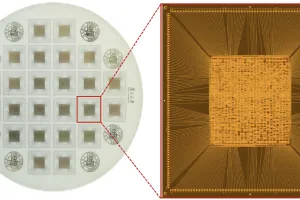
The tape-out validates the foundational components of Ubitium’s architecture: the Universal Processing Array with runtime reconfiguration and LPDDR5 memory interface. A second tape-out is targeted for later this year, with volume production in 2027.
Ubitium’s universal processor spans general-purpose computing, real-time signal processing, and massively parallel AI inference on a single die; in a homogeneous architecture
It has full Linux and RTOS support, standard RISC-V toolchains, and compatibility with modern software frameworks. No need for proprietary languages or vendor-specific compilers.
It targets radar and multi-sensor signal chains, real-time audio and voice, computer vision, edge AI, automotive cockpits, industrial HMI.
The Universal Processing Array shifts execution mode at runtime (CPU, DSP, GPU, parallel accelerator) without context-switch penalty or external offload.
Ubitium offers one processor, one toolchain, one qualification cycle and reduced BOM cost, board complexity, and supplier dependencies across product lifecycles.
See all our processor content.