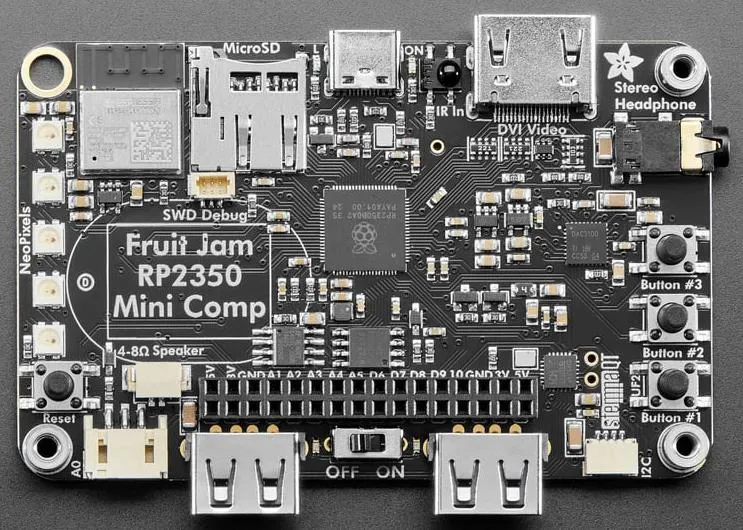
The credit card-sized Fruit Jam has the larger (80pad) version of the 150MHz dual-core Cortex M33 MCU, alongside 16Mbyte of flash and 8Mbyte of PSRAM.
“It’s like a mini computer, plug in a monitor, keyboard and mouse to make applications in CircuitPython, Arduino or even Pico SDK,” according to Adafruit. “The PSRAM will help when we want to do things like run emulations that we need to store in fast RAM access, and also let us use the main SRAM as the DVI video buffer.”
Operating displays up to 640 pixels, or a little wider, are practical, it added.
The keyboard and mouse are enabled by an onboard two-port, USB type A hub, and there is a USB type C connector for boot-loading and to use the board as a USB client.
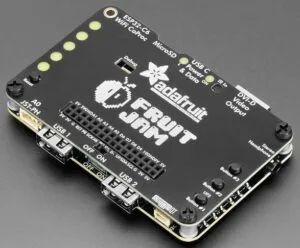
Sound is through I2S, with a TLV320DAC3100 providing stereo headphone drive and a 60mW Class-D amplifier for the offboard mini mono loudspeaker that is included in the package – which also includes an annotated top cover for the board (left).
A second microcontroller supports 2.4GHz Wi-Fi 6 – an ESP32-C6 from Espressif, which has its own 160MHz 32-bit Risc-V core and can communicate over Bluetooth 5 LE and the 802.15.4 protocol.
Other interfaces include ‘Stemma QT’ I2C via a 3pin JST connector, the RP2350B ‘PicoProbe’ debug port, a Micro SD card slot and a 16pin header with 10ADC GPIO connections, as well as 5V, 3V and GND power pins.
For simple interactions there are five multi-colour LEDs and three general purpose push buttons, plus a reset push button.
Find the Fruit Jam on this AdaFruit web page