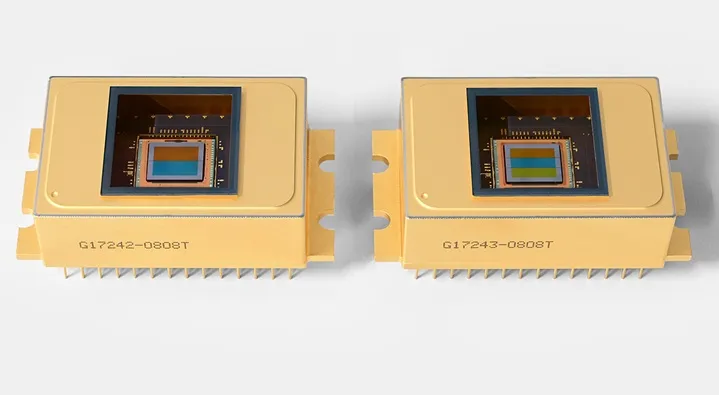
Aimed at both R&D and industrial engineering, possible applications include food inspection, material analysis and metal exploration.
Pixels
The number of effective pixels is 320 × 240, with a pixel pitch of 20 μm. And this can translate to different image sizes: 6.40 mm × 1.60 mm (1.7 μm area), 6.40 mm × 1.60 mm (2.2 μm area) and 6.40 mm × 1.60 mm (2.6 μm area).
Spectral response
The company highlights the product’s wide spectral response range, 3500:1, across varying light intensities. Specifically, 900 nm to 1650 nm (1.7 μm area); 1300 nm to 2150 nm (2.2 μm area); and 1700 nm to 2550 nm (2.6 μm area).
Features include 4-port analog output, for connectivity options, a frame rate of 503 frames per second for imaging in real-time, dynamic environments, and multi-line readout functionality, allowing for simultaneous data readout across multiple lines. There is also a built-in timing generator, to help reduce setup complexity.
Operation modes
Finally, there are flexible operation modes. For example, the ability to switch between “integrate while readout” and “integrate then readout” functions. This is to allow for customisable imaging strategies tailored for specific application needs, says Hamamatsu.
You can read the more on the Hamamatsu Photonics website.