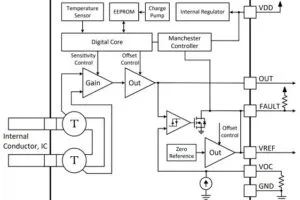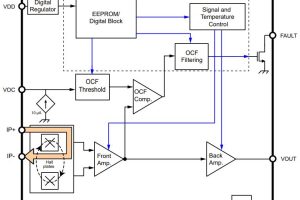
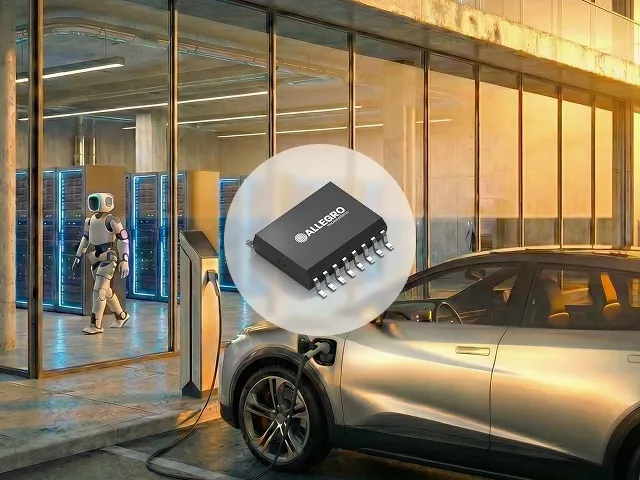
The device integrates a stable, non-ratiometric voltage reference, eliminating the need for external precision voltage reference components on the PCB, says Allegro. It highlights that this not only saves board space (and reduces BOM) but also removes a source of system-level noise and error.
Features
Allegro specifies the ACS37017 as follows:
- ±0.55% sensitivity error (typical)
- ±3mV offset error over temperature and lifetime
- 750 kHz bandwidth with a 1 µs typical response time
- Zero current voltage reference output for differential signal routing
- 0.85 mΩ SOICW-16 package supports 5000 VRMS withstand voltage and ±800 VPK/565 VRMS reinforced isolation
- Reinforced isolation for safety in high-voltage EV and industrial systems
Hall effect current sensor
The company claims the Hall effect current sensor sets an industry benchmark for accuracy:
“With 0.55% typical accuracy, it offers the ultra-low drift and precise signal conditioning required for the most demanding control loops in high-voltage power conversion.”
“If you need to catch a fault in 50 nanoseconds, we have the award-winning ACS37100 XtremeSense TMR current sensor,” adds Matt Hein, Business Line Director of Current Sensors at Allegro MicroSystems. If you need to sense high power in a tiny footprint, we have the high-density ACS37200. And now, with the ACS37017, if your priority is absolute accuracy, we have the definitive solution.
Image: Allegro MicroSystems
See also: Reed switches vs Hall effect switches