VENTUNO Q comes with 16 GB RAM — able to handle concurrent inference and complex multitasking — and an expandable 64 GB of storage.
“With VENTUNO Q, AI can finally move from the cloud into the physical world. This platform makes it possible to build machines that perceive, decide, and act — all on a single board.” says Fabio Violante, VP & GM, Arduino, Qualcomm Technologies, Inc. “Our goal is to make advanced robotics and edge AI accessible to every developer, educator, and innovator. VENTUNO Q is the natural evolution of Arduino’s mission, and a major step toward bringing real‑world intelligence to everyone.”
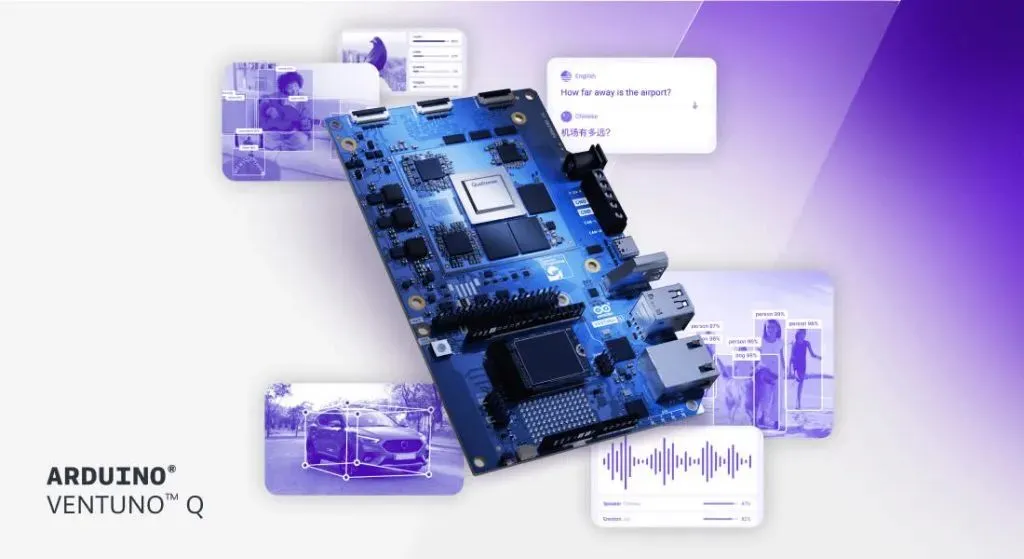
With VENTUNO Q, users will be able to prototype and build solutions for a variety of fields, running fully autonomous AI agents offline. For example:
- AI-powered systems: completely offline AI voice assistants running local LLM models; smart mirrors that respond to gestures; tourist kiosks, healthcare desks, or transport hubs that leverage automatic speech recognition (ASR) and text-to-speech (TTS) on the edge.
- Robotics and motion control: precise pick-and-place robotic arms guided by vision; service robots that recognize and follow their owners across dynamic environments; autonomous robots that navigate complex environments independently using Visual SLAM and path optimization.
- Edge AI vision and sensing systems: proactive security systems that spot hazardous behaviors; traffic monitoring devices that process complex data on the edge; automated quality inspection that use local VLMs to detect minute defects or missing components.
- Education & research: VENTUNO Q can serve as a key tool to teach anything from computer vision to generative AI on the edge, and is the ideal platform to quickly and easily develop functional prototypes in record time.
VENTUNO Q eliminates multi-device complexity because it delivers synchronized perception, decision, and action on a single board. The main processor runs Ubuntu and Linux Debian with upstream support, while the real‑time microcontroller runs the Arduino Core on Zephyr OS, ensuring deterministic behavior for time‑critical tasks.
What’s more, it enables users to build complex AI systems faster than ever through the seamless Arduino® App Lab environment, offering a unified development experience across Arduino sketches, Python scripts, and a range of ready-to-use AI models — including local LLMs, VLMs, automatic speech recognition, gesture recognition, pose estimation, and object tracking entirely offline powered by Qualcomm AI Hub. And for advanced projects which require custom AI models, Arduino App Lab is now integrated with Edge Impulse Studio. More AI frameworks will be supported soon.
VENTUNO Q can be connected to a PC or used as a single-board computer (SBC). Unlike general-purpose AI SBCs, it is engineered from the ground up for machines that move, react, and manipulate.
In addition to tightly integrating a real-time MCU and an NPU-accelerated MPU, on the hardware side it features:
- Industrial I/Os that include native CAN‑FD, PWM, and high-speed GPIO for precise physical control;
- ROS 2-ready workflows and robotics use cases are baked directly into the platform;
- High-speed connectors for multiple MIPI‑CSI cameras (with the ability to process multiple feeds with AI), advanced audio, displays, and 2.5 Gb Ethernet.
Combined with unmatched hardware compatibility — VENTUNO Q works out‑of‑the‑box with UNO shields and carriers, Arduino® Modulino™ nodes and Qwiic sensors, as well as Raspberry Pi Hats — these features make for one of the most flexible and developer‑friendly Edge AI ecosystems ever built.
Arduino VENTUNO Q will be available in Q2 2026 from the Arduino Store, as well as via our network of official resellers including DigiKey, Farnell, Macfos, Mouser and RS. Sign up today for updates at https://www.arduino.cc/product-ventuno-q