

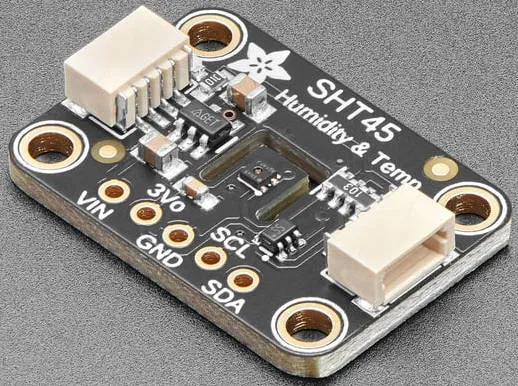
Annoyingly, the chip only has a single I2C address option, but here a second Adafruit product comes to the rescue: a I2C multiplexer breakout board (below left), which comes in connector (Stemma QT) and solderable versions.
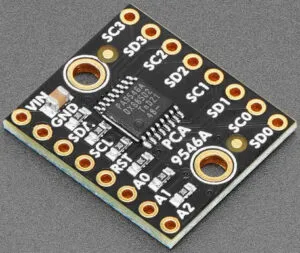
There multiplexer board both allow up to four identically-addressed I2C products to share the same bus without conflicts – Adafruit also does an eight-channel (connector-only) version.
Note: the sensor boards are available with or without a dust-excluding PTFE membrane over the humidity ports.
What are a pair of humidity/temperature sensors of interest?
Because: knowing humidity and temperature allows ‘dew-point’ to be calculated, and knowing dew-point inside and outside a building – a workshop not so far from here, for example – can tell its owner when opening the windows will remove rather than increase dampness inside as winter approaches, for example.
Given pressure as well, the owner of said workshop could be informed when ventilation is no longer a possible answer, and it is time to close the windows and turn on some heating to prevent condensation forming on those beautiful-but-fragile exposed steel surfaces.

The internal guttering in my garage is working overtime at the moment.
It doesn’t catch everything but helps a bit.
It was like a swamp in there yesterday.