

5G networks covered 55% of the world’s population at the end of 2025, but access is highly uneven. In high-income countries, over 80% of the population has 5G coverage, while in low-income countries, less than 5% do.
The urban-rural gap is also particularly pronounced: globally, 66% of urban residents have 5G access, compared to just 40% in rural areas.
Regions like East Asia, led by China, South Korea, and Japan, are at the forefront of 5G deployment, with China alone surpassing the 1 billion 5G connections mark in 2024 and reaching near-universal urban coverage.
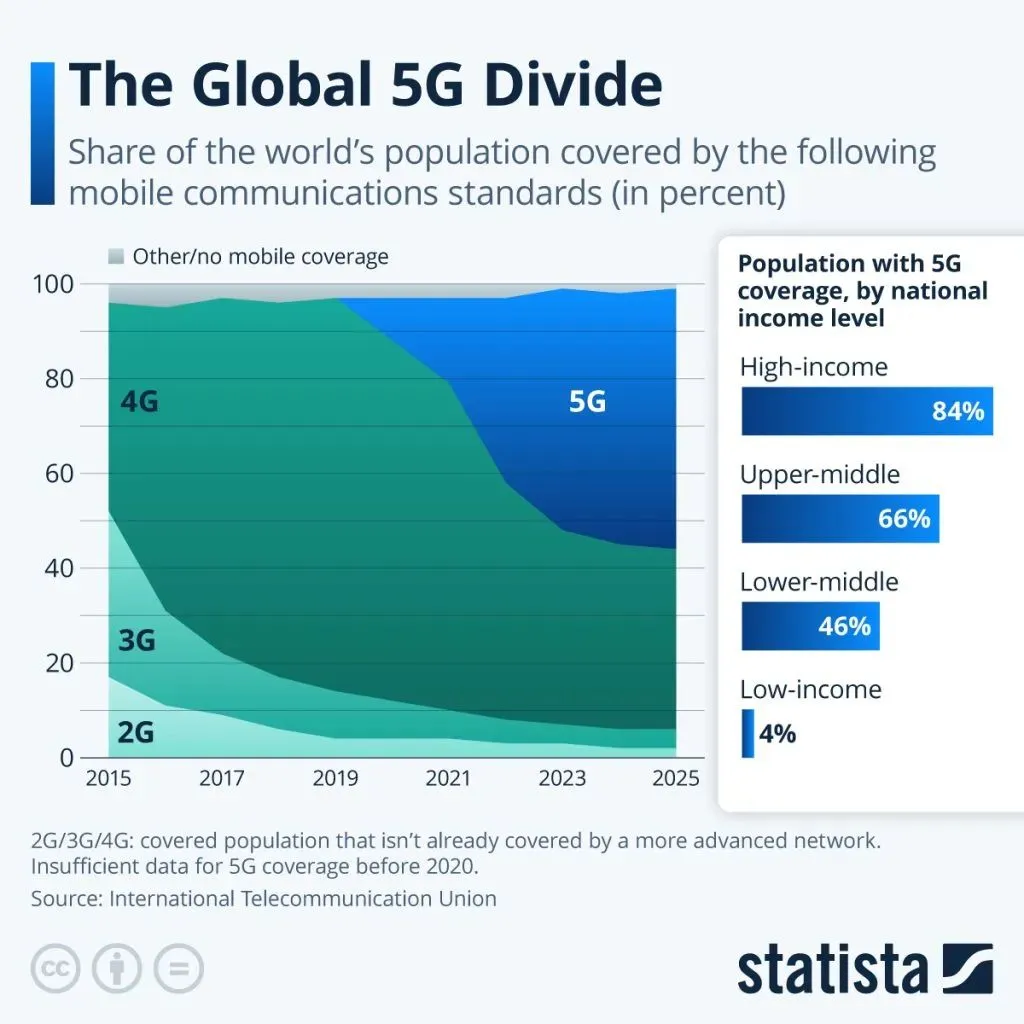
South Korea was the first to launch 5G and now enjoys nearly 100% coverage nationwide, followed by countries such as Denmark, the Netherlands, Switzerland, Singapore and Japan (98 to 99%).
North America, particularly the United States and Canada, also shows coverage and adoption above the global average, with over 300 million 5G connections and rapid expansion in both urban and suburban areas.
In contrast, much of Africa and some parts of South Asia and Latin America remain far behind. For example, it was estimated that only 12% of the African population would be covered by 5G by the end of 2025, with rural areas often completely unserved.
Elsewhere in the world, countries like India, while making progress (40% 5G coverage in 2025), still face significant barriers due to infrastructure costs and regulatory challenges.


Of course Machine Learning (Non Gen AI) has been a massive part of efficient network management for many years. I’m waiting for 6G to be monikered as AI driven. Or indeed existing 5G vendors starting to push the AI acronym.
Yes indeed Jamo, there was the dotcom monicker, the IoT monicker now the AI monicker – the pulling power of each of them rather fizzled out in fairly short order.
Of course IoT is becoming a potential disaster since many appliances are being hijacked as part of huge bot networks. A recent example of what’s happening was highlighted by an independent engineer who ‘inadvertently’ gained access to a network of autonomous vacuum cleaners. He gained access to their cameras giving great views inside the houses 🙂
We are doomed.
What a strange civilization is the one whose users of vacuum cleaners want their appliance to be equipped with digital cameras
Actually, one key question, after seeing how poorly pervasive the 5G has been in fields other than broadband and how limited are the everyday advantages of 5G vs 4G services, is: will there be any chance to generate reasonable RoIs with 6G?
Good point Mauro, In the public networks, a new wireless generation is only ever used to relieve congestion in the previous generation, it seems. Therefore, the answer is no.