Over my several decades in microelectronics, I have always appreciated venture capitalists for their ability to invest in risky projects they envision will become highly successful.
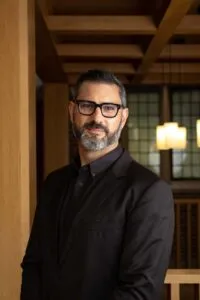
My guest is someone I have been following on LinkedIn and greatly admire as one such a venture capitalist. The intriguing posts about startups successfully raising funding with Miles’ help and about various new technologies caught my eye. My interest was piqued, so I reached out to Miles, and like a true gentleman and scholar, he agreed to an interview.
It’s absolutely wonderful to listen to people as they talk about their past. For me, it’s an immersive experience as I can stand, watch, and, in Miles’ case, chronicle events from his past, almost as if I were there but invisible. It’s a real privilege for me to learn and share Miles’ journey.
Miles smiled as those heady days at university brought back happy memories for him. He was an undergraduate in Electronics and Communications at Bristol University back in 1990 when a flatmate studying Biology introduced him to a lady at a dinner party also studying Biology. Beth was an American from California, and the chemistry between them blossomed into a marvellous relationship – one that stood the test of time, growing ever stronger with each passing year, even to this present day.
After graduating, Miles left the UK with a backpack…BACKPACK only! No suitcase, no fuss. Perhaps that was an early sign of what was to come later. He moved to California to be with Beth, and joined Qualcomm as a product manager. He happily told me about watching Whales and his surfing days. Imagine a sun-drenched day, seagulls squawking while people milled around on a sandy white beach. Miles was in the water waiting for a 7ft wave and then plucked up the courage to use his surfboard. Unfortunately, his board broke in half, but he was unharmed.
At Qualcomm back in the late 90s, 3G was just around the corner, with Hong Kong and the US heavily investing in subsequent growing networks. His job took him to Brazil, India and Russia, all keen to replace wired networks with wireless.
Miles completed an MBA while working full-time at the University of California. Imagine having a full day at work, 9 am till 6pm or later. Then returning home, having a bite to eat and then study. Hard? You’re not kidding and then starting the same routine the next day. It’s very tough, but then nothing Miles did was ever easy. He just makes it look easy!!
In 2001 joined the venture capital group set up by Qualcomm. This was the inflexion point in Miles’ life. During his tenure, he met many entrepreneurs who no doubt wanted to convince him to invest in their venture. A few MIT scientists successfully persuaded Miles and secured funding. Qualcomm acquired one of these ventures for advanced display technology.
Miles recalled the trying times working with the display group as they experienced a series of difficulties. As a testament to Miles’ character, he stood by them as they tried to work through Fab and yield issues. If you’ve been there, you can empathise as the handles of the vice turn and the pressure mounts. Sleepless nights, waking up in the early hours in the hope that the dawn of a new day would solve the pressing problems. Sadly, OLEDs and advances in LCD technology superseded this venture, but that didn’t hinder Miles’ enthusiasm.
In 2007, the CEO and CTO of Qualcomm asked Miles to sketch out what new areas Qualcomm could expand into next, leveraging the $11B+ of cash and equivalents the company had built up. With the significant connections at Miles’ disposal, he quickly discovered research conducted on Machine Learning, ML, at the SALK Institute. He built an internal programme to develop chips to implement ML while the key scientist focused on algorithmic development. There were multiple other areas, such as Augmented Reality, where Qualcomm built the largest developer community in the world for AR, an efficient near-field magnetic resonance for wireless charging, which Formula E deployed on BMW cars. The team also developed a special road with built-in electromagnetics to allow cars to charge continuously as they drive along the road.
Miles returned to the UK in 2012 after 20 years in California to run the Qualcomm Venture group in Europe and invested in Formula E and Chargemaster, later acquired by BP. In 2016, he joined Oxford Capital, and invested in UltraSoC. Rupert Baines was the CEO of UltraSoC, which, as we know from Rupert’s story, Siemens acquired. Miles also invested in Latent Logic, which Waymo acquired. He then went on to set up a US$150M fund for AV8 Ventures and then founded Deeptech labs with Arm, the University of Cambridge and Cambridge Innovation Capital. A short pause here for a few words by yours truly. Serial successes are delightful to read, but the vision and effort required to achieve this is so significant words do little justice. The amount of research leading to subsequent due diligence not only in the technology, but in guiding the leadership of these companies requires tremendous skills.
Returning to Miles, he is passionate about new technology and believes that the research conducted in the UK is, at least as good and, in many cases, better than in the US. The problem we face here is commercialisation. There is a lot of new technology currently in development at British Universities, such as green energy, AI, chips for AI, Data centres, new materials and next-generation optical switching.
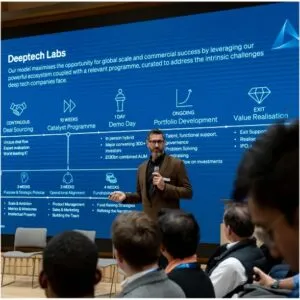
Miles went on to give statistics that only 32% of deep tech startups succeed in transitioning from Seed to the next round of funding in the UK. Miles puts this down to the ecosystem here in the UK. In the Bay area, entrepreneurs at a restaurant or bar rub shoulders with others of similar mindsets, VCs, and those who have successfully exited. Consequently, its has historically been much easier to get the advice and support to build a successful company there.
With this in mind, Miles established a dedicated three-month programme for his portfolio companies and to date, 53 companies have successfully completed it. The first month focuses on the potential scale of the opportunity. At the one on one sessions, seasoned experts and veterans meet with founders to help them optimise and refine their vision. Experts include the founders of Darktrace, Arm, serial entrepeneurs, ex-heads of IP from Qualcomm & Arm and top VCs. In the second month, the focus is on implementation of the vision, including determining the product offering, beachhead market and team to implement the next phase of business, and the third month is focused on the full story and plan and pitch for demo day.
At the last demo days in December over 650 people signed up to attend, 420 of whom are investors, to see 10 Deeptech Labs startups. As a consequence of the Deeptech Labs’ accelerator programme, the success rate jumped from 32% to 75% of companies transitioning from Seed to the next round of funding. Examples include Salience Labs that has just raised $30m in their Series A round.
As the interview came to an end and I said my goodbyes, I was still buzzing with what Miles had told me. I’ve always believed that our great country has some truly brilliant minds at work and right now, someone somewhere is having a Eureka moment. However, these people need Miles to take their idea to a commercial stage. Miles is not only a unique visionary, but he’s also armed with the tools, deep knowledge, and drive to help entrepreneurs transition from incubation to a successful company.
I am very grateful to Miles for allowing me to write this short blog and, perhaps, we could follow up on a second with more detail about his accelerator program.
See also: Viewpoint: Rupert Baines – Serial entrepreneur, permanently curious