
Smart rings that track your sleep and heart rate, advanced robotics enabling precision surgery, solid-state batteries set to transform how we store power – electronics are at the heart of innovation. Electronics are not just powering our modern world; they are the modern world.
As the demand for smarter, faster, and more connected technologies grows, so too does the industry’s responsibility to embed sustainability into the DNA of innovation. Circularity, once viewed as an end-of-life product concern, is emerging as a powerful lever for extending their useful life, maximizing material recovery, and reducing environmental impact.
With the global electronics industry now responsible for one-fifth of world trade, we have an opportunity, and arguably, an obligation, to lead the shift.
The shift begins not with any single solution, but with a mindset. Circularity must be embedded across the entire value chain: how we design components, train the next generation of talent, and create systems. Encouragingly, signs of progress are already taking shape. Three areas in particular offer near-term opportunities for lasting impact.
Starting with the smallest parts
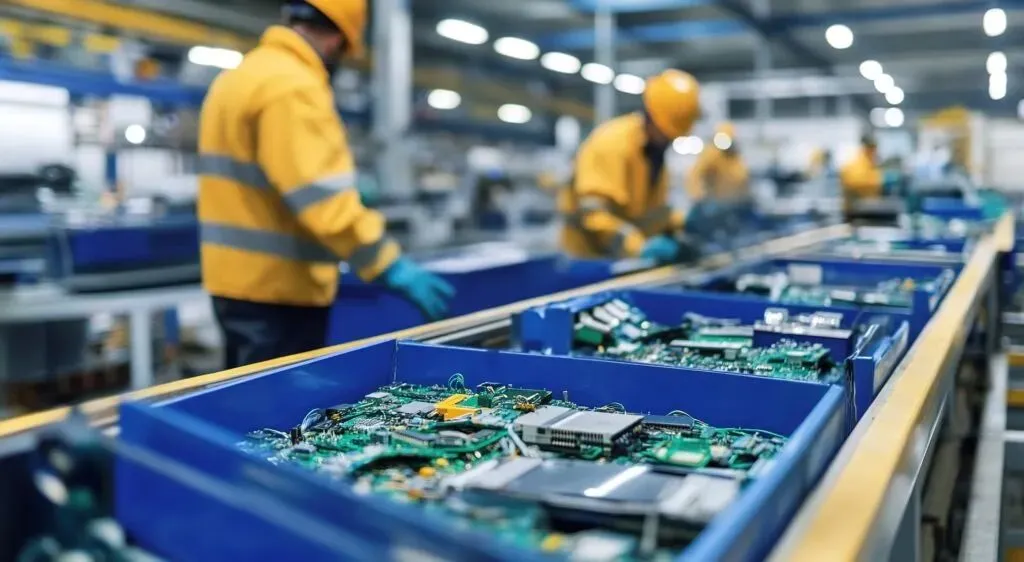
When electronics reach end-of-life, the focus is often on entire devices like phones, tablets, or servers, but the high-value components inside are just as critical to address. These components are inside many products, including refrigerators, automobiles, and medical equipment. Semiconductors, capacitors, and PCBs are complex to recover, often due to disassembly challenges and a lack of traceability once integrated.
Yet the trade in electronics inputs [i.e., semiconductors, connectors, and batteries, rather than finished electronics like laptops and phones] for these components now exceeds the $2trillion trade in finished electronics, totalling more than $2.5trillion globally in 2023, making them a strategic target for reuse. More effective recovery could help reduce demand for virgin materials, improve supply chain resilience and unlock new business opportunities in refurbishment and manufacturing. [Source: Global Electronics Association report: Global Electronics Trade in an Age of Disruption June 2025]
Emerging solutions such as AI-assisted sorting, desoldering technologies, and labelling frameworks are making it easier to reclaim components safely and efficiently. Efforts to create ‘Component CVs’ – traceable records of a part’s usage and performance history – could also help ensure that recovered parts meet quality and safety standards.
Industry repair and rework standards are evolving as well, supporting technical staff in the reclaim and reuse process. The development of new guidance focused on component-level recovery, in addition to established rework protocols, can accelerate consistency and trust across the industry.
Circularity in mind
The best time to integrate circularity is long before the product reaches the end of its useful life. Decisions made at the design stage – such as how to connect components, what materials to use, and how accessible parts are – can dramatically influence a product’s recoverability and longevity.
An increasing share of electronics companies are incorporating circularity into early-stage design, with nearly 60% citing cost savings and efficiency as key motivators. [Source: Global Electronics Association report: Global Electronics Trade in an Age of Disruption June 2025] Gaps still remain, however. Design for disassembly and material recovery is still not standard practice, and reliable data to inform life cycle assessments is often hard to access.
To address this, the industry is exploring new ways to improve material visibility and environmental impact tracking throughout a product’s life. Better access to consistent, comparable data can help engineers make more informed design decisions that support circularity without compromising functionality, cost, or performance.
There is also momentum behind simplified product architecture, use of standardised fasteners, and reduced material complexity, all of which make disassembly and reuse more practical at scale.
While no single design strategy fits every product, the industry is steadily building a toolkit to help teams incorporate circularity alongside performance and efficiency.
Preparing for what is next
Circular systems do not run on technology alone, they depend on people. From design engineers to factory-floor technicians, the shift toward circularity requires new skills, updated training, and greater awareness across the ecosystem.
Workforce development is emerging as one of the most important, and most overlooked, enablers of circularity. Today, repair and refurbishment jobs are growing, but awareness and education remain limited across much of the industry.
To move forward, stakeholders across the electronics industry are calling for investment in circular skills training, updates to engineering curricula, and more collaboration across the value chain to share best practices. Real-world case studies that demonstrate cost savings, emissions reductions, or product performance benefits can also help drive change inside organizations.
When the workforce is equipped with both the knowledge and tools to support recovery and reuse, circularity becomes achievable and scalable.
An industry effort
Circularity offers the electronics industry an opportunity. The shift requires better access to environmental data, more coordinated supply chain efforts, and a shared commitment to redesigning systems that were built for linear use. The tools are there, and the momentum is building. Now is the time to make circularity part of how we lead.
 Dr John W Mitchell is president and CEO, Global Electronics Association (formerly the IPC).
The Association’s lead sustainability strategist, Dr Kelly Scanlon, is a guest on Electronics Weekly’s CHIIPs podcast (09 September episode).