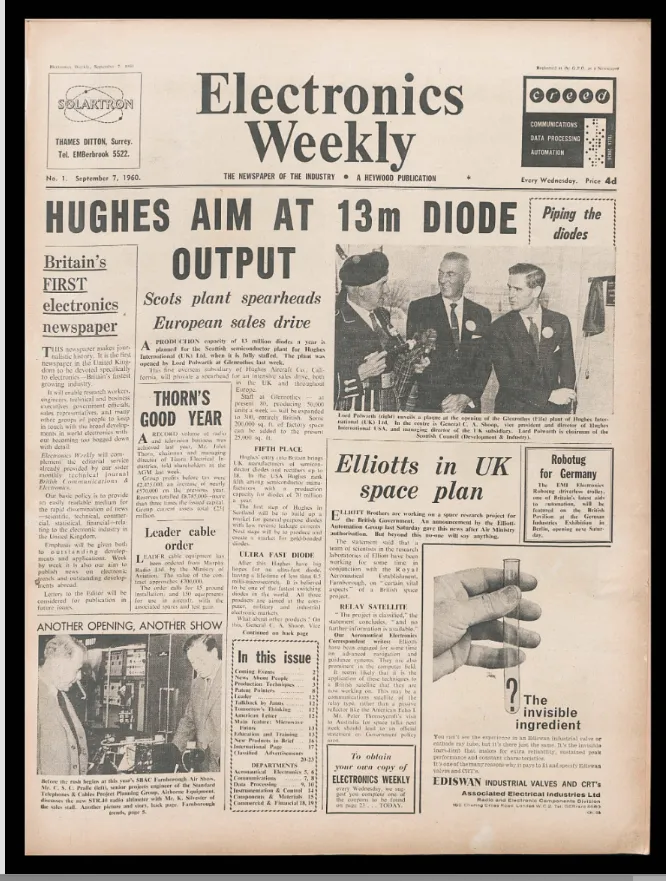
In the UK, Harold Macmillian was Prime Minister, leading a conservative government; Dwight David “Ike” Eisenhower was the US president but only for the next couple of months. He and his vice-president Richard Nixon were to lose to John F Kennedy and running mate Lyndon B Johnson in November that year. The other major political power during this Cold War period was Russia, led by President Nikita Khrushchev.
You can read the very first issue of Electronics Weekly »
The new black and white print magazine reported on news of the UK’s space industry, its telecommunications projects and early semiconductor industry.
Over the last 65 years, Electronics Weekly has charted the rise (and fall) of major companies, identifying early trends that grew into significant industry movements that shape our world today.
See also:
- Editors’ picks: Reflections on the first issue of Electronics Weekly
- From print to podcasts: 65 year-legacy of Electronics Weekly – timeline
Digital
As the world became digital, Electronics Weekly launched its website in 1999, making its news and analysis accessible to an international audience via the internet.
Then the world embraced multimedia and in 2018 Electronics Weekly introduced its EW-TV channel, which hosts video content, including interviews with exhibitors and industry commentators and reels from exhibitions and conferences.
Since 2000, Electronics Weekly‘s newsletters have enabled news stories to be brought directly into readers’ inboxes and in 2007 a digital version of the issue was introduced. The digital issue appeals to readers who want to access news, product innovations and technical features via a laptop, tablet or phone.
At the same time, it opened up the editorial content to readers outside the UK. Today, the readership is equally spread across UK and Europe, the Americas and Asia.
CHIIPs
The latest innovation, reflecting how information is consumed in the 21st century, is Electronics Weekly‘s podcast series, CHIIPs. Since March of this year, guests have shared their insights about technology, thoughts on training, recruitment and encouraging interest in STEM subjects as well as start-up and careers advice.
Electronics Weekly has adapted and evolved as the demands and tastes of readers and the industry it serves have changed. This change has meant not just a shift from monochrome paper editions to colour print and digital issues but a whole suite of ways that readers can access the information they need: online, in print or through its social media presence. Today, Electronics Weekly is still the barometer of the electronics industry. Its team of renowned and expert journalists is highly regarded for its online news updates, analysis and comment and blogs as well as professionally produced video and audio content.
Elektra Awards
Electronics Weekly also champions the industry. In 2003 it introduced the Elektra Awards, celebrating the best of design, innovation and technical excellence in the electronics industry. In 2017 Electronics Weekly introduced BrightSparks – promoting young and emerging talent in the electronics industry. And in 20024 we introduced Women Leaders in Electronics Awards, to focus the spotlight on women who have forged a career path, managed, mentored or shown entrepreneurial flair in an industry where they are often overshadowed.
Things have indeed changed a lot since 1960: then no one had heard of The Beatles, the European Economic Community was a fledging economical ideal and not every home had a landline telephone or TV.
What hasn’t changed, is Electronics Weekly‘s incisive reporting and comprehensive coverage of the electronics industry from innovations to implications, and from personalities to politics.
Electronics Weekly remains one of the longest standing and trustworthy names for anyone in the electronics industry.
Your memories
Celebrate our first 65 years with us! Tell us when you first started reading Electronics Weekly. What was the news story that got you hooked? Did you appear in Electronics Weekly? Share your stories.
Leave a comment below or share your thoughts on our LinkedIn page.


Hughes on the front page – the expanded site is still in operation under Raytheon, but the semiconductor business and fab closed in 2017. By then Silicon Carbide had become the most interesting semiconductor material, and it still lives on as the spinout/startup Clas-SiC Wafer Fab Ltd. It’s an open SiC foundry, is very successful globally, especially in its Licensing, Royalty and Consulting model – a Chinese fab is based on its semiconductor processes is now up and running and a new Indian fab was announced this year in Odisha.
I remember the poor secretary at HP R&D in South Queensferry carrying around about a hundred copies each week and dumping them on every desk. I think she gave up on actually putting them on the right desk since everyone got a copy.
Then Electronic Times appeared and it doubled the workload, so she got a rack of individual pigeonholes made and installed so we had to collect our own.
The copies would be thick as well, I’m sure – hopefully more of a burden to carry than to read!
And all those job ads. Them were the days.
It always makes I laugh to see adverts for “Experienced Men required” Salary £850 p.a.
That was history. And, to be fair, for the salary, it was almost in the days when the big, white five pound notes were personally signed by the Governor of the Bank of England!
Also degrees weren’t essential: you could get decent jobs with a HNC.
Which didn’t cost you £9k/yr.
Fees for my first year of HNC in 1974 were £4.
Congratulations to Electronics Weekly on 65 years! It’s amazing to see how far the industry has come. Excited to see what the future holds!
Thank you, Ollie!
And yes, here’s to the next 65, and all they hold!
Since about 1986 when I started full-time at Ferranti Electronic Ltd at Gem Mill in Oldham, but saw it also in my vacation jobs there in 84/85. Can’t recall any specific stories that got me hooked, but liked all the Spectrum/Sinclair and BBC Micro stories as we made a lot of their chips. The Transputer was another UK processor story I thought was going to have a bigger impact than it ever did.
Thanks for sharing Martin.
Ferranti – what a name…and the (almost legendary) Transputer. So sad it never took off… (in ’89 I remember doing a module on parallel programming, taught by someone from the Transputer centre that was located in Sheffield at the time. Occam was the language, with its own neat ‘folding’ editor…)