Imec has given Jensen Huang, founder and CEO of Nvidia, its 2026 Lifetime of Innovation Award. The honour recognises Huang’s instrumental role in enabling accelerated computing technologies and empowering critical AI applications across industries – fuelled by the invention of the GPU. The award ceremony, including a video interview with Huang, will be held on 19 May, during imec’s ITF ...
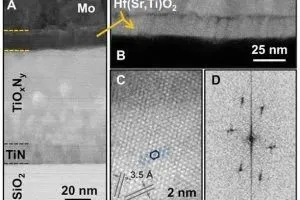
Researchers at the University of Cambridge have proposed an answer to escalating energy consumption of AI hardware – multicomponent p-type Hf(Sr,Ti)O2 thin films for memristor-based neuromorphic devices. ‘Neuromorphic computing offers promises to drastically reduce this footprint,’ say the researchers, ‘here, we introduce multicomponent p-type Hf(Sr,Ti)O2 thin films for energy-efficient, resistive switching–based neuromorphic devices. We demonstrate interfacial memristors with ultralow switching ...
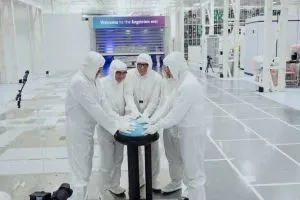
Imec has received the ASML EXE:5200 High NA EUV lithography system, said to be the most advanced lithography tool available today. The tool gives imec’s partners early access to the next generation of chip-scaling technologies. Integrated directly with a comprehensive suite of patterning and metrology tools and materials, the High NA EUV system will empower imec and its ecosystem partners ...
The government announced today that it is to spend £2bn on quantum computing research over the next four years. The Department of Science, Innovation and Technology (DSIT) says it is encouraging companies to initially build prototype quantum computers with a view to having commercial versions available in the next decade. DSIT is targeting applications in financial services, quantum navigation, energy and pharmaceuticals. ...
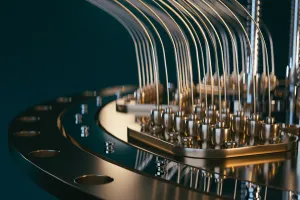
IBM has published a quantum‑centric supercomputing reference architecture – a blueprint for integrating quantum computing into modern supercomputing environments. IBM’s progress in extending useful quantum computing to HPC is discussed here. Technical detail about the first reference architecture for quantum-centric supercomputing is available here. The architecture shows how quantum processors (QPUs) can work alongside GPUs and CPUs, across on‑premises systems, ...
The University of Sheffield is leading a £12.5 million national research centre to strengthen the UK’s ability to design electronic systems and support the UK Semiconductor Strategy. The Centre for Heterogeneous Integrated MicroElectronic and Semiconductor Systems (CHIMES) will develop new ways to integrate ICs into smaller, faster and more energy-efficient systems. The future lies in “Heterogeneous Integration” – combining different ...
The UK’s most powerful quantum computer will be based at the University of Cambridge as part of a partnership with quantum specialist IonQ. The partnership will support the creation of the IonQ Quantum Innovation Centre to be based at the Ray Dolby Centre, the new home of Cambridge’s Cavendish Laboratory. The centre will house an IonQ 256-qubit quantum computer. “Access ...
SpaceForge has launched the National Microgravity Research Centre (NMRC), the terrestrial arm of its low-Earth-orbit manufacturing programme. The Cardiff-based company is developing technologies to produce advanced materials in microgravity. It says the microgravity environment reduces the exposure to contaminants such as moisture, dust and gases, potentially resulting in up to 100-times fewer defects in semiconductor materials. The proposal is to ...
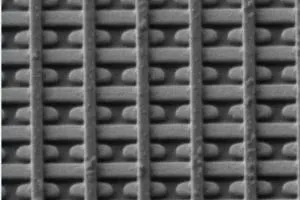
Cornell University researchers have used high-resolution 3D imaging to detect atomic-scale defects in ICs. The imaging method was the result of a collaboration with TSMC and ASM and the research was funded by TSMC. Tiny defects have been a long-standing challenge for the semiconductor industry. The game-changer is electron ptychography, a computational imaging method in which an electron microscope pixel ...
Imec and Atlas Data Storage, a specialist in production-scale DNA data storage, have joined forces to to accelerate the development of digital data storage using synthetic DNA. The collaboration combines Atlas’ ASIC design expertise and scalable DNA synthesis technology with imec’s expertise in advanced chip development, fabrication, and integration. In addition to prototyping and strategic support, imec is investing in ...