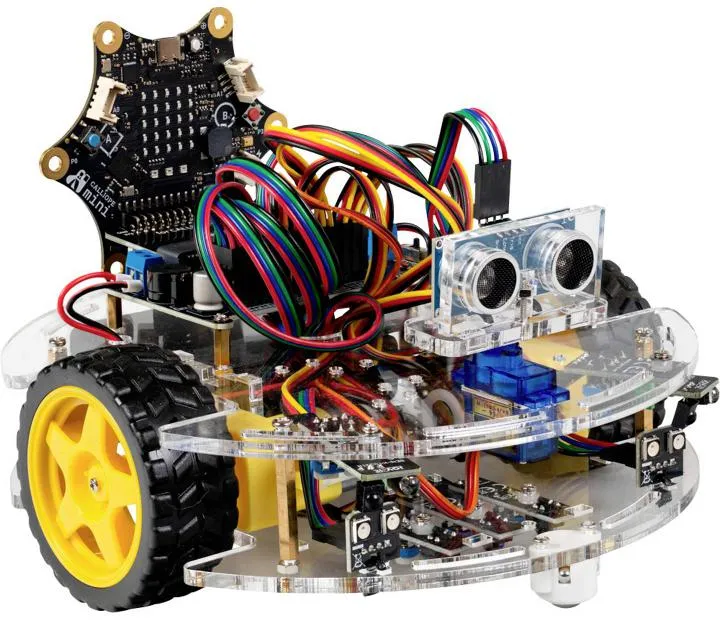
“It features a horn, indicator lights, headlights, reversing and brake lights as well as line tracking, ultrasound, infrared and wheel speed sensors,” said Conrad. “Depending on your programming skills, these modules can be operated by a variety of both entry and advanced programming languages, simulating the behaviour of an autonomously driven vehicle. Which is precisely what you need to make technical education exciting and interactive.”
The Calliope part of the name refers to ‘Calliope mini 3’, the star-shaped single-board computer (bought separately) on the rear of the Joy-Car (see photo) which is already familiar to teachers and students in Germany.
It has a 189 x 171mm footprint and is 133mm high.
There is also a BBC micro:bit controlled version of Joy-Car, which is shorter at 77mm high.
“Compared to the micro:bit, the Calliope mini offers more integrated components such as an RGB LED, a speaker, Grove connections and larger terminals that are particularly suitable for children’s hands,” according to Joy-iT.
For apprentices and undergraduates, either version of Calliope can be programmed in MicroPython, and for younger users either version will work with Fraunhofer’s Open Roberta project. The drag-and-drop block-based Make Code language can also be used.
“Children from the age of nine can use Open Roberta to familiarise themselves in a playful manner with robotics, electronics and programming – no prior knowledge required,” said Conrad. “Open Roberta was specifically designed for STEM lessons and uses the open-source visual programming language NEPO.”
Find Calliope Joy-Car on this Conrad web page (does not include a Calliope mini 3), and the micro:bit version is here (does not include a BBC micro:bit).
In September, iFixit took a look inside the Go2 robotic dog