
The goal, eventually, is to power Moon surface exploration.
Investment was led by Outlast Fund and Linas Sargautis, an angel investor and a former co-founder of NanoAvionics.
Note, the company has also secured an additional €580K via public contracts and grants by the European Space Agency (ESA), NATO DIANA, and the Latvian government.
Defence
“Our technology, which has already been validated in the laboratory, has several applications across the defence and space sectors,” said Deep Space Energy co-founder, and CEO, Dr. Mihails Ščepanskis.
“First, we’re developing an auxiliary energy source to enhance the resilience of strategic satellites,” he said. “It provides the redundancy of satellite power systems by supplying backup power that does not depend on solar energy, making it crucial for high-value military reconnaissance assets.”
Radioisotope
As mentioned, Deep Space Energy’s technology is based on radioisotopes, materials derived from nuclear waste. Basically, generating heat through its decay – converting heat into electric power.
According to the company, it requires five times less radioisotope fuel than a thermo-electric generator (RTG).
Dual-use satellites
The company highlights that its radioisotope-based energy generator is not designed for weaponry. In the immediate future, it says the technology will target dual-use satellites to increase their resilience and operational reliability.
Specifically, satellites operating in Medium Earth Orbit (MEO), Geostationary Orbit (GEO) and Highly Elliptical Orbit (HEO), which can be critical for modern military reconnaissance and early-warning systems.
Moon power
In the longer term, the company aims to focus on the Moon economy. It says the radioisotope power generator will be able to address the energy challenges in the next phase of lunar exploration. For example, NASA and ESA’s Artemis, Argonaut and lunar rover programmes.
For example, the technology will enable support lunar night survival and operations in permanently shadowed regions. This is for enabling extended scouting and prospecting missions.
With night temperatures dropping below 150 degrees Celsius, moonrovers can’t always rely on solar power when nights last for roughly 354 hours.
Deep Space Energy
Deep Space Energy has its headuarters in Latvia and has an office in the UK.
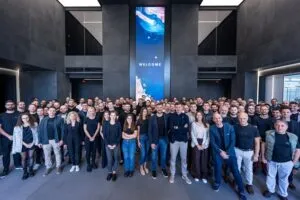
Image: Deep Space Energy – left to right: Linas Sargautis (advisor), Prof. Jānis Priede (Chief Scientist, co-founder), Dr. Mihails Ščepanskis (CEO, co-founder), Olga Barreto Goncalves (BD & Project Manager) (Photo by: Bruno Kabucis)
See also: NASA asks for proposals for moon nuclear power plant