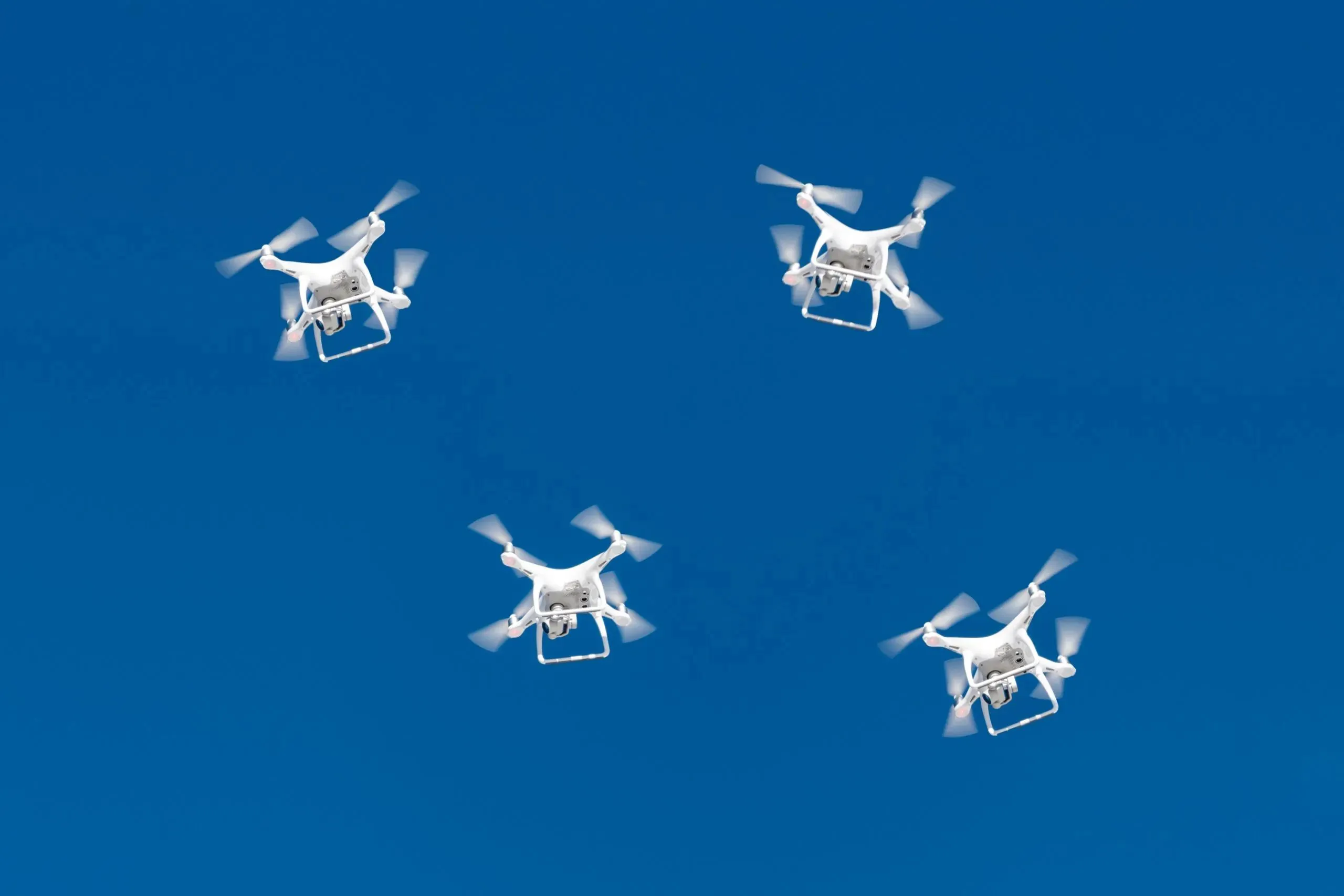
Using swarms of drones to autonomously perform critical or labour-intensive missions, such as assembling structures in challenging environments (e.g. field hospitals), monitoring large expanses of agricultural land for pests, structural health surveys, or for security purposes (e.g. intercepting other drones in sensitive areas), is attracting an increasing amount of R&D activity. These high-functioning, multi-robot systems typically seek to use the latest collaborative simultaneous localisation and mapping technology, known as C-SLAM.
Robotic swarm technology has evolved significantly over the past 10 to 15 years. Some early examples were pre-programmed teams of unmanned aerial vehicles (UAVs) or drones providing eye-catching LED displays in the sky. These multi-robot systems typically consisted of a handful of drones, operated via a centralised platform, were unable to communicate with each other or make decisions autonomously.
Driven by growing demand for adaptive swarm technology for the defence and security industries, software developers have been exploring ways to secure de-centralised communication so that multi-robot systems can act and behave autonomously, whilst mitigating the risk of being hijacked by third parties. De-centralised decision-making becomes harder to achieve as swarms scale in size because line-of-sight communication from one drone to another across the swarm is often no longer possible.
Scientists at the Massachusetts Institute of Technology (MIT) have been experimenting, using blockchain to secure drone-to-drone communications. By combining peer-to-peer networks with cryptographic algorithms, they found that a group of ‘agents’ can reach consensus on a specific course of action and record it, without the need for a central controlling authority. This allows a robotic swarm system to operate securely and autonomously; making decisions as one and adapting to an unstructured environment.
Some emerging technologies are focused on equipping robotic swarms for complex or challenging applications, such as identifying and taking out combat or trespassing drones. Munich-based company, Alpine Eagle has filed a patent application in the US (US2025273060) for a distributed sensor network that allows an adaptive robotic swarm to establish an aerial exclusion zone, and detect and track hostile drones entering the space. The company has also recently taken part in a UK MoD-run project to find new methods for detecting and defeating unmanned aerial systems (UAS).
Other innovators have been developing systems that will allow adaptive heterogenous multi-robot teams to perform complex tasks autonomously in remote, unstructured environments. OffWorld has recently filed an international (PCT) patent application (WO2025085841) for systems and methods that allow a team of industrial robots to autonomously communicate and work together, with each individual robot performing a specialised task under the guidance of an elected squad leader. The patent application refers to potential industrial use cases, including mining and other heavy industry operations.
In smart agriculture, adaptive robotic swarms are increasingly deployed. SwarmFarm Robotics has deployed swarms of small autonomous robots across farms in Australia and the US incorporating patented path planning technology (US12093049B2) to allow them to work collaboratively on tasks like spraying, mowing and data collection. This activity is challenging the paradigm of traditional tractor-focused agriculture. Multi-robot systems are also being developed to detect plant diseases and pests, and take action autonomously to control or manage them.
Chemspeed Technologies has sought patent protection (EP4551014A1) for a swarm of drones which have sensors for detecting a pest infestation, and which fly over the crops autonomously and use a laser for eliminating any pests detected.
Adaptive robotic swarms could also play a role in search and rescue. A high degree of adaptability is required to allow a multi-robot swarm to react and respond to a rapidly unfolding situation, such as an earthquake. Based in Helsinki, Fly4Future has developed swarm drones that can cooperate to search large areas of challenging terrain, such as forests, to reduce search times to locate people in need.
In this rapidly advancing field of R&D, it is especially important for developers to understand what can and can’t be patented. Whilst much UAV-related hardware has been around for decades, and may not be patentable, the software-based systems that control it could be. In a market that is not fully developed, including a broad scope of potential use cases in patent applications is advisable to broaden commercial protection and bring further opportunities to license technologies in new areas in the future.
Samuel Bateman is a senior associate and patent attorney, and Chris Froud is a partner and patent attorney, at European IP firm, Withers & Rogers.

Chris Froud

Sam Bateman