
Researchers at the University of Cambridge have proposed an answer to escalating energy consumption of AI hardware – multicomponent p-type Hf(Sr,Ti)O2 thin films for memristor-based neuromorphic devices.
‘Neuromorphic computing offers promises to drastically reduce this footprint,’ say the researchers, ‘here, we introduce multicomponent p-type Hf(Sr,Ti)O2 thin films for energy-efficient, resistive switching–based neuromorphic devices. We demonstrate interfacial memristors with ultralow switching currents (≤~10−8 A), exceptional cycle-to-cycle and device-to-device uniformities, and retention >105 s.’
They reveal hundreds of ultralow conductance levels with a modulation range of >50 (without reaching any saturation) and reproducibly satisfy unsupervised learning rules.
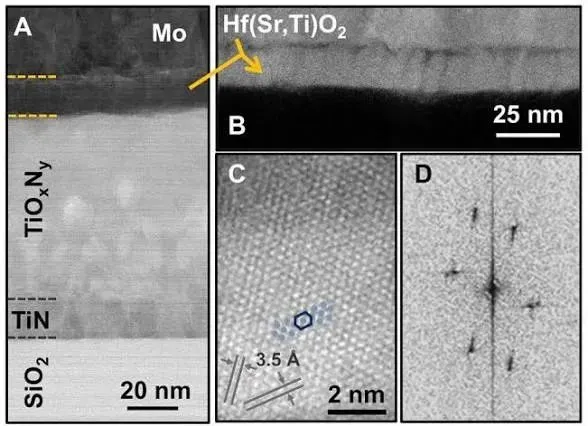
This performance originates from incorporating a self-assembled p-n heterointerface between p-type Hf(Sr,Ti)O2and n-type TiOxNy, resulting in a fully depleted space-charge layer asymmetrically extended into Hf(Sr,Ti)O2, a large built-in potential, and extremely low saturation current density under reverse bias.
“Energy consumption is one of the key challenges in current AI hardware,” says researcher Dr. Babak Bakhit, “to address that, you need devices with extremely low currents, excellent stability, outstanding uniformity across switching cycles and devices, and the ability to switch between many distinct states.”
Ultralow conductance modulation is controlled by tuning p-n heterointerface’s energy-barrier height through electro-ionic charge migration. This materials-engineering strategy addresses energy consumption and variability in existing memristors, opening a pathway toward energy-efficient neuromorphic computing systems.