SI estimates 2026 capex will be $200 billion, up 20% from 2025.
TSMC was the largest spender in 2025 with $40.9 billion in capex, 25% of the total. TSMC projects 2026 capex will be between $52 billion and $56 billion, an increase of 27% to 37% from 2025. The company cited 5G, AI and HPC as drivers of the increase in capex.
Other foundries are projecting flat to down capex in 2026, except for GlobalFoundries with a 70% increase.
On March 21, Elon Musk announced plans for Terrafab, a wafer fab to provide semiconductor devices for Musk’s companies Tesla, SpaceX and xAI.
The fab will be built in Austin, Texas, at a cost of $20 billion to $25 billion.
When complete, the fab will have a capacity of one million wafer starts per month at a 2nm process node. Tech Insider predicts Terrafab will have initial production in 2028 and full production in 2032.
The $25 billion cost spread out over six years is just over $4 billion a year. In 2026, Terrafab will acquire land, build infrastructure and likely begin building.
SI estimates Terrafab will spend $3 billion in capex in 2026. SI is placing Terrafab in the foundry category since its devices will be used by Musk’s companies and not sold on the open market.
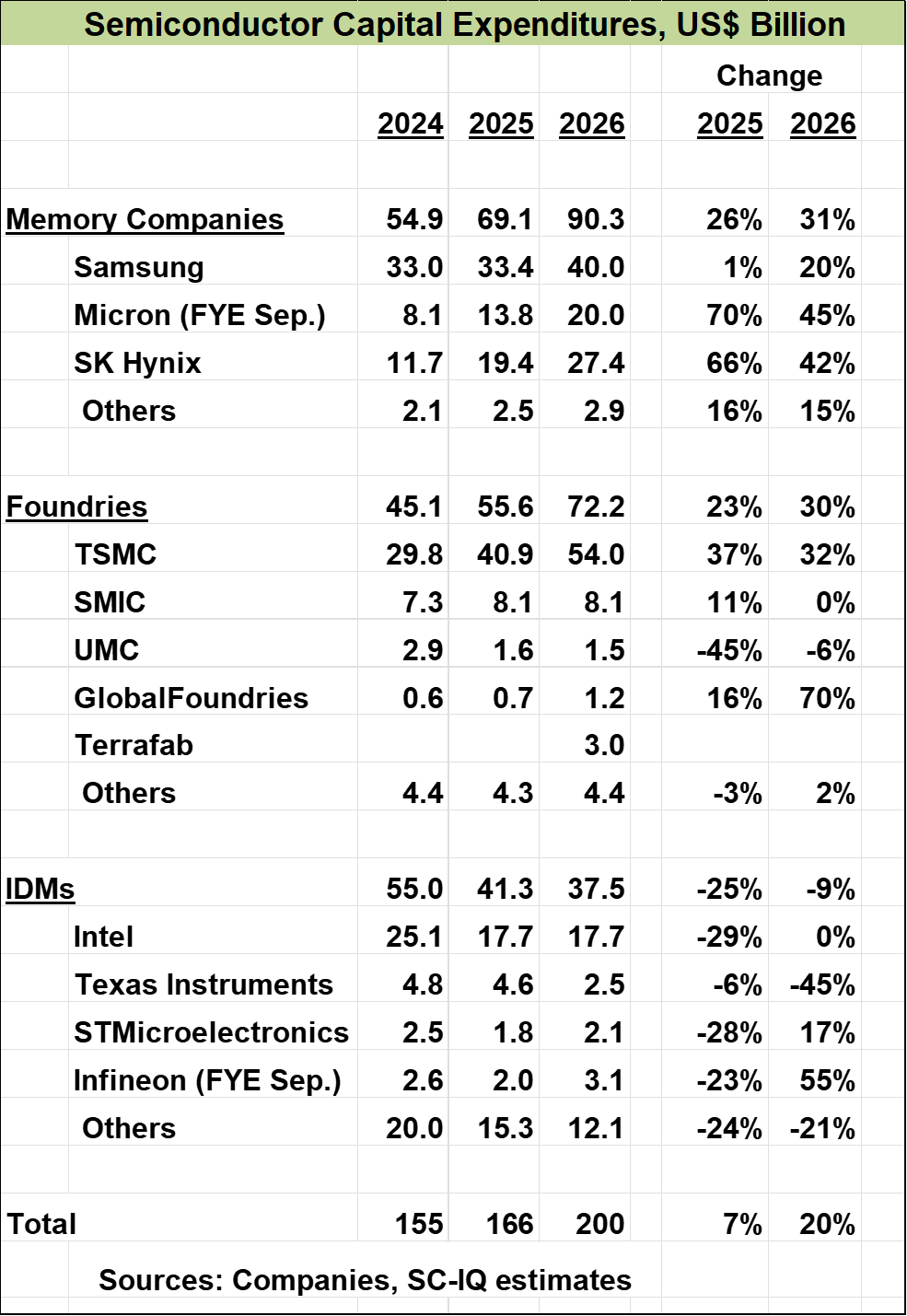
Memory companies will account for the largest percentage of capex in 2026 at 45%.
Samsung announced it will spend over 110 trillion won ($74 billion) in 2026 to “secure leadership in the AI semiconductor era”. SI estimates about $34 billion of this investment will go toward R&D and non-semiconductor capex, leaving $40 billion for semiconductor capex, an increase of 20% from 2025.
Micron Technology and SK Hynix each should increase capex by over 40% in 2026.
The IDMs spent $41.3 billion on capex in 2025, down 25% from 2024. IDM capex should decline again in 2026 by about 9%. The decline in IDM CapEx is largely due to AI driving market growth. Most of the AI semiconductor market is supplied by memory companies and fabless companies such as Nvidia.
Intel capex in 2025 was $17.7 billion, down 29% from 2024. Intel expects flat to down capex in 2026. For many years, Intel was one of the overall top three spenders along with Samsung and TSMC. Intel was passed by SK Hynix in 2025 and will be passed by Micron Technology in 2026.
TI will spend between $2 billion and $3 billion in capex in 2026, down from $4.6 billion in 2025 as it aligns with market conditions.
STMicroelectronics and Infineon Technologies both plan capex increases in 2026.
What is the appropriate level of capex relative to the semiconductor market?
The semiconductor market is notoriously volatile. Over the last forty years, annual change has ranged from 46% growth in 1984 to a 32% decline in 2001.
Although the industry has become somewhat less volatile as it has matured, in the last few years it has shown an 8% decrease in 2023 and a 26% increase in 2025.
Semiconductor companies need to plan their capacity several years out. It takes about two years to build a new wafer fab and additional time for planning and financing.
As a result, the ratio of semiconductor capex to the semiconductor market varies greatly, as shown below.
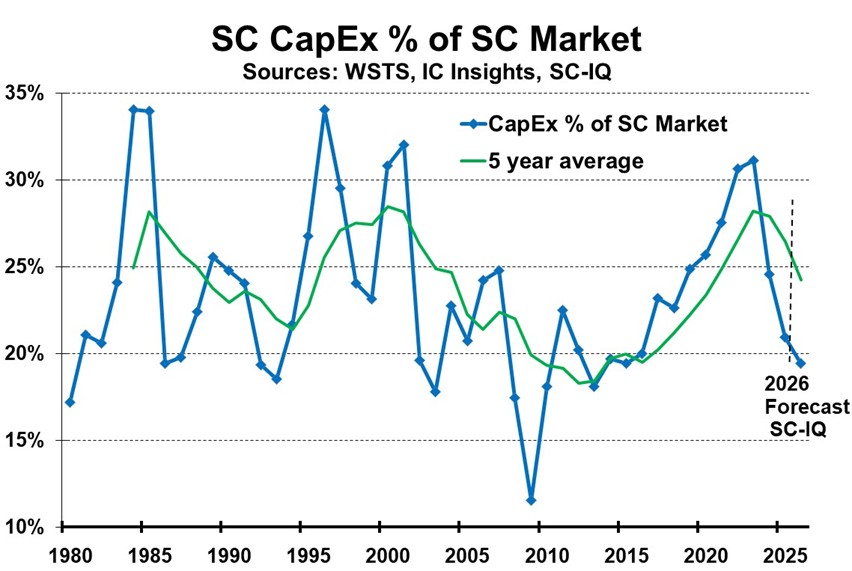
The semiconductor capex to market size ratio has varied from a high of 34% to a low of 12%. The five-year-average ratio ranges between 28% and 18%. Over the total period of 1980 to 2025,
Capex was 23% of the semiconductor market. In 2023, the ratio was 31.1%, one of only seven times in the last 45 years it has been over 30%.
The five-year-average ratio was 28.2%, only the third time since 1980 it has exceeded 28%. The ratio dropped to 25% in 2024 and 21% in 2025. Our current projection is that the ratio will drop to 19% in 2026 and the five-year-average ratio will drop to 24%.
Thus, despite expected 20% growth in 2026, total capex does not appear to exceed the growth of the semiconductor market.
If the semiconductor market continues healthy growth over the next few years, the industry should not have overcapacity.