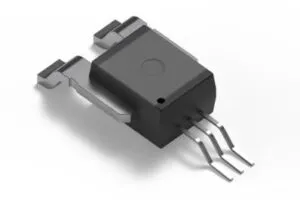

These are mosfet choppers, but they tend to cost over £100 and are often poorly documented as they are made as drop-in replacements for treadmill motor controllers such as the MC2100ELS.
Interfacing to them can also be tricky as some are design to work with a potentiometer that is at mains potential in use – so user protection has to be via an insulating case and knob.
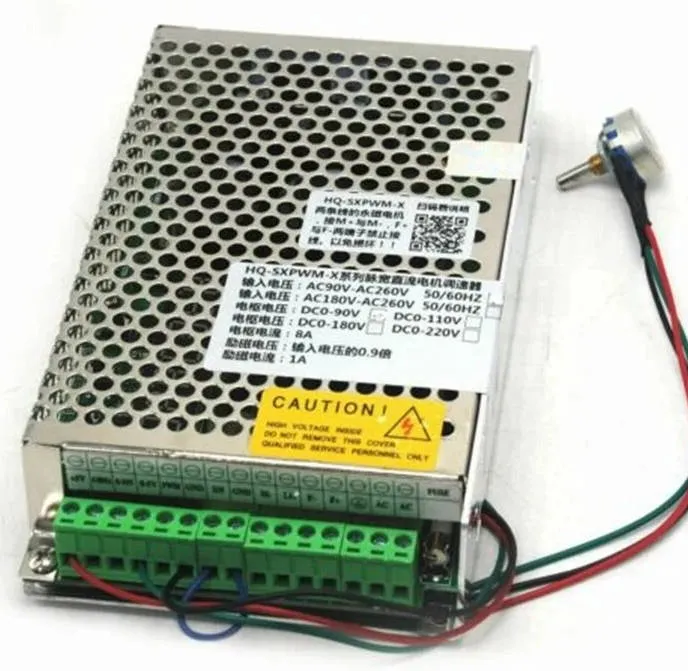
Enter the HQ-SXPWM, a mains fed controller that I had not come across before, even though it has been around for several years and is available through Ebay and Amazon.
This seems to be a mosfet-based mains chopper that runs at 16kHz and has electrically-isolated control inputs for PWM, a potentiometer or an analogue voltage. Price is around £55 to £65.
Its parameters are not adjusted via on-board preset potentiometers, but via three push-buttons and two four digit seven-segment displays inside the metal outer casing.
Max output voltage, current limit, IR-compensation (which prevents the motor slowing under load), soft-start duration and soft stop duration are among the parameters that can be changed.
It comes in HQ-SXPWM-X and HQ-SXPWM-A versions (no idea of the difference), and also in versions for 90Vdc motors.
It looks good on paper, but is the electrical isolation good enough to safely protect humans, or is it simply to prevent interference?
With no other way to find out, one has been ordered, so watch this space if the answer is of interest to you – with any luck, the operating voltage of the mosfets will also be revealed – as an opinion here is that the perceived fragility of mosfet controllers is sometimes down to poor transient suppression and the 450V mosfets instead of 650V devices.
Now I need to work out how to filter 16kHz from a cable.
Why not SCR control?
SCR speed controllers that supply 180Vdc motors from 240Vac mains are wonderfully robust, but have the drawback that they always present fast-rising voltage edges to the motor’s armature at a 100Hz (or 120Hz, depending on mains frequency) repetition rate.
As the armature does not have much inductance, this approach will result in high current impulses that eat away the motor’s brushes and produce high EMI unless an additional external inductance is placed in series with armature.
These near-essential inductors are large, heavy and expensive.
Operating at several kHz gives the armature’s inductance a fighting chance to maintain continuous current flow via the controller’s fly-back diodes without an external inductor.
Rengan Krishna Iyer has a youtube video that runs through HQ-SXPWM control settings.
This is part of series of blogs related to CNC machines
The image above is taken from the ebay advert of the retailer I used.