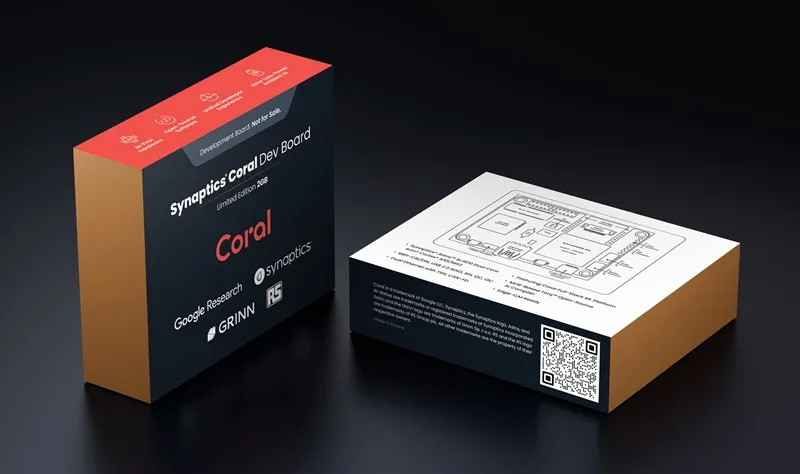
It is targeted at AI and ML engineers, system architects and ODMs/OEMs, says Synaptics. And it is designed to support experimentation and rapid production prototyping.
Coral Dev Board
The Coral Dev Board uses the 1 TOPS Synaptics Torq NPU and features the industry’s first implementation of the Coral NPU from Google Research.

It targets ultra-low power AI support for wearables, hearables and smart home appliances. Synapitics is also expecting to address automation hubs, industrial control systems and robotics.
Read all our Embedded World content »
Basically, the Coral Dev Board is for always-on applications using ambient sensing. It enables on-device inference, supporting all-day AI experiences in battery-constrained form factors, say the companies.
In terms of hardware interfaces, there is camera and display support via CSI/DSI and USB, microphone inputs and Wi-Fi/Bluetooth connectivity through an M.2 expansion slot.
Coral NPU
“The Gemma family of open models [make] its state-of-the-art AI research more accessible to developers and researchers,” said Olivier Lacombe, product lead, Google DeepMind.
“With the Synaptics Coral Dev Board, developers can immediately start developing with Gemma 3 270M on optimised Edge hardware, enabling fast iteration and new classes of on-device generative and perception-based applications.”
For its part, Synaptics highlighted its commitment to open-source models.
“The Synaptics Coral Dev Board reflects our commitment to building an open, developer-first Edge AI ecosystem,” said Vikram Gupta, senior vice-president and general manager, Edge Compute & Connectivity Solutions, Synaptics. “With our Astra SL2610 product line, backed by open-source models, tools, and a ready-to-use development experience, we’re accelerating the prototyping to production design cycle. This development board is the first of many we plan to create in partnership with Google Research as we continue expanding our Edge AI ecosystem.”
Astra SR80

Synaptics has also unveiled its Astra SR80 (above) and SRW1500 series of MCUs.
The Astra SR80 series powers high-performance, immersive audio applications, says the company. While the Astra SRW1500 series enables “more personalised intelligence generated and securely managed on-device across IoT networks”.
It features the Arm Cortex-M52 with Helium DSP, which is an energy-efficient implementation of the Armv8.1-M architecture. It runs at 200MHz, alongside a 200MHz, 50 GOPS Arm U55 NPU for on-device inferencing. There is also Wi-Fi 7 connectivity.
More information is on the company website.
Astra AI-Native
Last year, in January 2025, Synaptics collaborated with Google on Edge AI for the IoT, we reported. This was the Synaptics Astra AI-Native compute platform for IoT. This was to define the optimal implementation of multimodal processing for context-aware computing.
The collaboration involved integrating Google’s MLIR-compliant ML core on the Synaptics Astra hardware with open-source software and tools.
You can find Synaptics at Embedded World at 4A.259.
Image: Synaptics