The release adds State-of-Health estimation, adaptive battery modelling, and long-term fleet analytics capabilities, says Nordic. Basically, extending battery management for a wider range of power-constrained IoT products.
Fuel Gauge
Fuel Gauge v2.0 runs on any host MCU or wireless System-on-Chip, highlights Nordic, including the nRF54 Series, nRF91 Series, and also non-Nordic hosts.
“Battery behaviour in the field rarely matches what you see in the lab,” said Geir Kjosavik, Product Director PMICs at Nordic Semiconductor. “With Fuel Gauge v2.0, we’re bringing adaptive, real-world intelligence that was once exclusive to premium consumer electronics into the IoT space. It’s a game changer for billions of battery-powered devices.”
nRF Cloud
As you would expect, v2.0 integrates with Nordic’s own cloud lifecycle services – nRF Cloud.
The IoT devices can automatically report State-of-Health, State-of-Charge, and battery-performance metrics without requiring custom cloud infrastructure.
François Baldassari, founder of Memfault and VP Software Services at Nordic Semiconductor comments as follows.
“Memfault was built to make sophisticated device insights accessible to every hardware team. By connecting Fuel Gauge v2.0 seamlessly to nRF Cloud, we give companies a powerful, scalable way to understand and improve device behavior across entire fleets. It’s the future of battery intelligence.”
The new version of the software is currently beta sampling to customers, with wider availability coming in June 2026. Its announcement comes from Embedded World 2026.
Adaptive model
As mentioned, Nordic highlights that version 2.0 introduces an adaptive model. That is to say, one that continuously compares the original battery profile with the battery’s actual behaviour over time.
This is designed to enable more accurate State-of-Health estimation, track charge-cycles and long-term degradation trends, even as batteries age.
Nordic writes:
“Traditional fuel-gauge ICs rely on fixed models or coulomb counting, which can drift over time. Nordic’s approach requires no dedicated fuel-gauge IC and instead uses the nPM1300’s built-in voltage, temperature, and current measurements, together with a smart host-based algorithm. This will deliver dedicated IC-level accuracy at a lower system cost, with reduced Bill of Materials complexity, and consume no power during sleep – significantly saving power compared to competing solutions.”
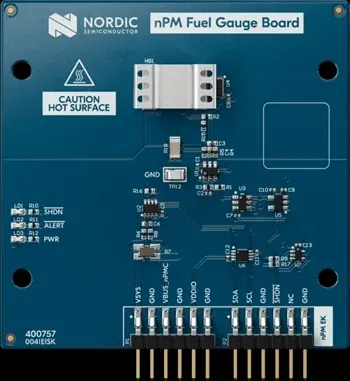
Image: The nPM Fuel Gauge board (nPM FG), which connects to compatible Nordic Semiconductor evaluation kits.
See also: Nordic adds NPU to wireless MCU