The chip’s AI engine supports a variety of neural networking model types, including CNNs, RNNs, LSTMs and GRUs, locally at the edge. According to Ambient Scientific, the SoC offers up to 100x improvements in power, performance and area compared to conventional 32-bit microcontrollers.
It is able to perform edge AI functions faster and at much lower power than today’s MCUs, NPUs or GPUs achieve, said the company. This is achieved by mapping the neural network model’s matrix-multiply operations and activation flows directly to in-memory analogue compute blocks. This eliminates wasted cycles and overhead which can be found in a conventional processor’s general-purpose instruction set, said CEO, GP Singh.
AI processing is performed in two sets of five MX8 AI cores in two separate power domains. One set is in an always-on block which supports ultra-lower power sensor interfacing and fusion. The example given is that the SoC consumes less than 100µW for always-on keyword spotting. The 10 MX8 cores perform up to 2,560 multiply-accumulate (MAC) operations per cycle, for peak AI throughput of 512-GOPs.
The compute function is supported by 2MB of on-chip SRAM. There is an Arm Cortex-M4F CPU core, a low power ADC, enhanced I2S logic, and interfaces for up to eight simultaneous analogue and 20 digital sensors; e.g., accelerometer or gyroscope.
Ambient Scientific provides the comprehensive Nebula™ AI enablement toolchain to accelerate the training, development and deployment of AI models to the GPX10 and GPX10 Pro. It is compatible with leading model training frameworks including TensorFlow, Keras and ONNX. The chip’s AI cores, which are programmable in the Nebula toolchain, give designers the flexibility to adapt to evolving AI model types and topologies.
Ambient Scientific also provides the SenseMesh™ hardware sensor fusion layer, which enables low-latency sensor fusion by connecting multiple sensors to a core via a tightly-coupled mesh. This produces instant responses to trigger events, and ultra-low Idle mode power, as it offloads sensor polling from the CPU.
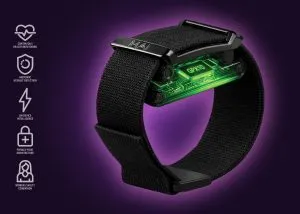
The GPX10 Pro can be used for local AI inference in wearable and monitoring edge and endpoint devices, including those powered by a single coin cell battery. Examples include pet collars, livestock monitors, smart rings and smart watches.
Later this year, Ambient Scientific will introduce the GPX64 which will have edge AI capability for use with robotics, drones and ADAS, said Singh. Its precision machine vision will be 10-50x higher resolution than exisiting devices, with around 300 frames per second and up to 520Mpixel performance, said Singh.
Other Embedded World news: