Dear fellow engineers, one of the most frustrating challenges in power supply design is when capacitors “let you down” due to severe capacitance degradation in low-temperature environments.
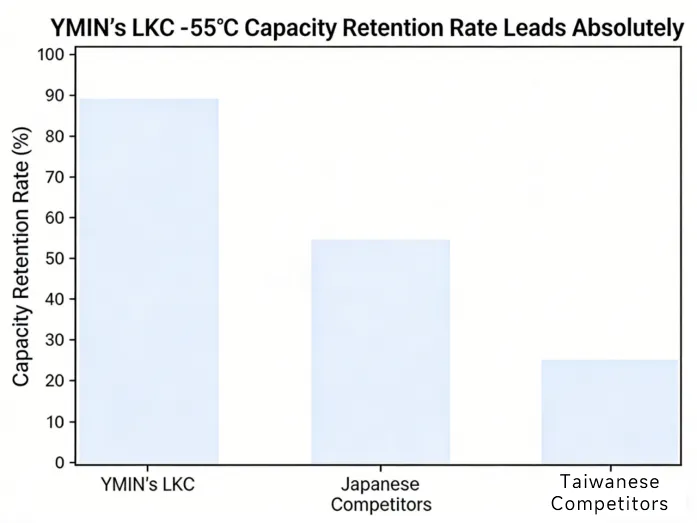
Today, through a set of real comparative test data, we take a deep dive into how the YMIN’s LKC series 450V 100 µF capacitor makes only 11.62% capacitance loss at −55 °C a reality.1. Focus of the Issue:
I. Problem Focus: How Severe Is Capacitance Degradation at Low Temperatures?
We selected YMIN’s LKC, Taiwanese, and Japanese competing capacitors of the same specification (100 µF / 450 V, 18 × 35 mm) and conducted capacitance and ESR measurements at 20 °C, -40 °C, and -55 °C.
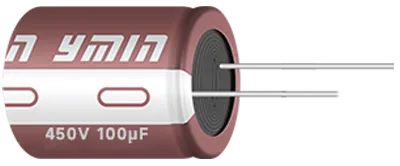
(Capacitor in 100 µF 450 V, 18 × 35 mm)
II. Data Comparison: The Performance “Gap” at -55 °C
(The following data are average values measured in YMIN’s laboratory – click to enlarge)
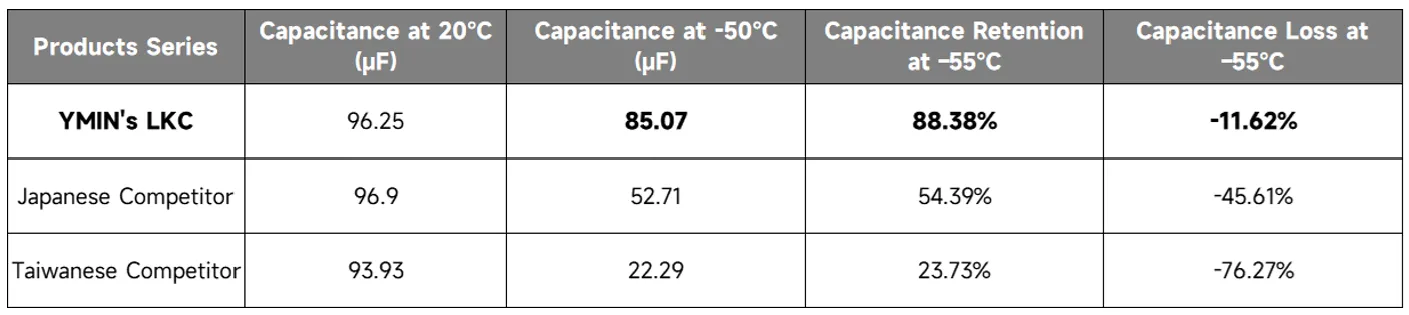
Key Conclusion:
Under the extreme condition of -55 °C, the actual usable capacitance of YMIN’s LKC (85.07 µF) is 3.8 times that of Taiwanese competitors and 1.6 times that of Japanese competitors. This means that during ultra-cold startup, LKC can deliver far more energy support than competing products, effectively preventing startup failures at low temperatures.
III. Technical Breakdown: How LKC Achieves Low-Temperature Advantage
1. Electrolyte Technology:
YMIN’s LKC uses a proprietary low-temperature, high-voltage electrolyte formulation. The core advantage lies in significantly reducing the electrolyte’s viscosity at low temperatures while maintaining high rated voltage. This ensures that ions still migrate efficiently at -55 °C, maintaining high conductivity—a fundamental factor for excellent capacitance retention.
2. Structural Optimization:
By optimizing the etching of the anode and cathode foils and the electrolyte impregnation process, LKC ensures internal structural stability and consistency during rapid temperature drops, avoiding performance fluctuations caused by microscopic structural issues.
IV. Design & Selection Guide
The YMIN’s LKC 450 V 100 µF capacitor is an ideal choice when your project faces the following challenges:
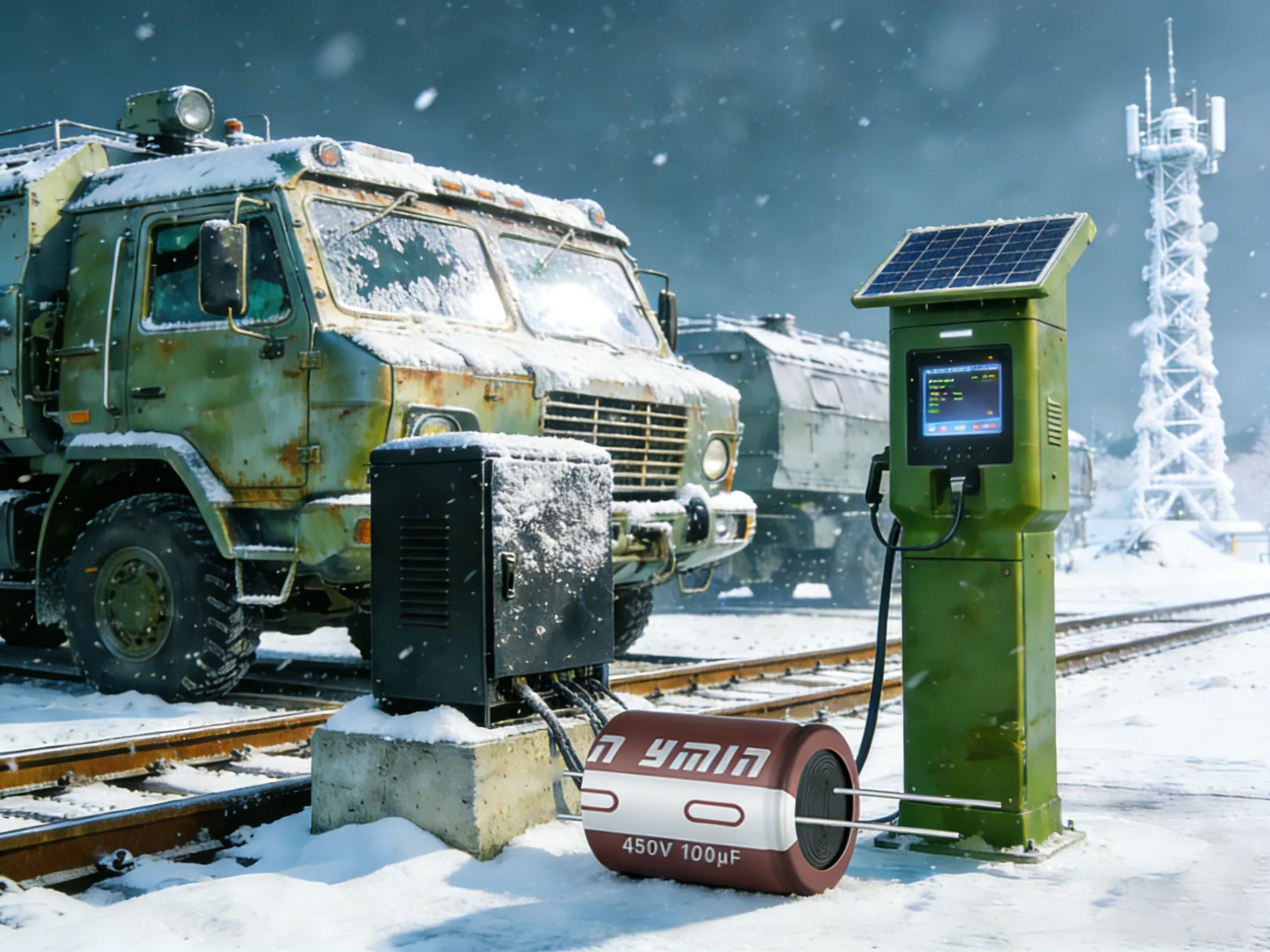
- Applications: Military power modules, cold-region rail auxiliary power, outdoor industrial power, DC fast-charging station bus capacitors.
- Requirements: Capacitance degradation must be strictly controlled within 15% at -40 °C to -55 °C.
- Replacement: Directly replace Japanese and Taiwanese high-voltage electrolytic capacitors that fail low-temperature tests in current applications.
Conclusion
For power engineers, reliable data is the strongest foundation for components selection. With only 11.62 % capacitance loss at -55 °C and exceptional capacitance retention, YMIN’s LKC series delivers data-backed performance, making it a compelling alternative to Japanese and Taiwanese competitors. The LKC series is ideal for industrial equipment, railway power supplies, charging stations, and similar applications. For inquiries, contact ymin-sale@ymin.com.