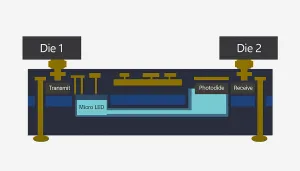
Singapore’s NSC (New Silicon Corporation) exhibited its latest project at Asia Photonics Expo 2026. Using silicon nitride waveguides and micro LEDs to connect, for example a GPU and high bandwidth memory results in 32Tbps/mm operation, compared to ~1.5Tbps/mm using copper, explained Niu Jing, a scientist at NSC.
There is no fibre alignment or lasers needed as the light is self-contained in the chip itself. Another advantage is that equivalent copper traces on existing interposers require greater power and therefore cause additional heating.
The research lab is working with commercial foundries such as Tower Semiconductor and the first tapeout is expected in the middle of this year.
NSC spun out from a research group within MIT’s research enterprise, the Singapore-MIT Alliance for Research and Technology (SMART) which conducted research into semiconductor and materials integration for the Low Energy Electronic Systems (LEES) research group. It describes itself as a “playground of creativity and a laboratory for exploration”. It encourages collaboration for chip design for innovation in extended reality, mobility, smart lighting, telecommunications and wearables.