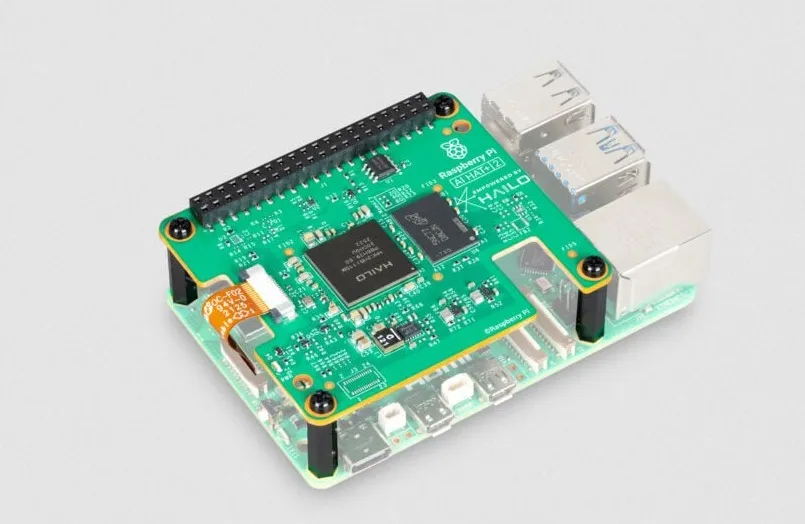
The previous add-on board featured the Hailo-8 (26-TOPS variant) and Hailo-8L (13-TOPS variant) neural network accelerators. But they lacked the capability to run generative AI models, which is what the AI HAT+ 2 addresses.
Possible applications include Raspberry Pi-based voice assistants, speech recognition and processing Vision Language Models (VLMs) such as interpreting scenes from a camera stream.
It is priced at $130.
Specification
The Raspberry Pi AI HAT+ 2 features the Hailo-10H neural network accelerator and delivers 40 TOPS (INT4) of inferencing performance. This is enough, says the company, to ensure generative AI workloads can run smoothly on the associated Raspberry Pi 5. This is processing locally and without a network connection
The AI HAT+ 2 features 8GB of dedicated onboard RAM to handle much larger sized models than before. For example, to accelerate large language models (LLMs), VLMs and other generative AI applications.
Naush Patuck, senior principal engineer at Raspberry Pi, writes: “For vision-based models — such as Yolo-based object recognition, pose estimation, and scene segmentation — the AI HAT+ 2’s computer vision performance is broadly equivalent to that of its 26-TOPS predecessor, thanks to the onboard RAM. It also benefits from the same tight integration with our camera software stack (libcamera, rpicam-apps, and Picamera2) as the original AI HAT+.”
AI HAT+ 2 LLMs
The LLMs available to install at launch are: DeepSeek-R1-Distill, Llama3.2, Qwen2.5-Coder, Qwen2.5-Instruct and Qwen2. These edge-based LLMs, sized to fit into the available onboard RAM, typically run at 1–7 billion parameters.
The AI HAT+ 2 also supports Low-Rank Adaptation (LoRA)-based fine-tuning of the language models, says Raspberry Pi, “enabling efficient, task-specific customisation of pre-trained LLMs while keeping most of the base model parameters frozen”.
Setup
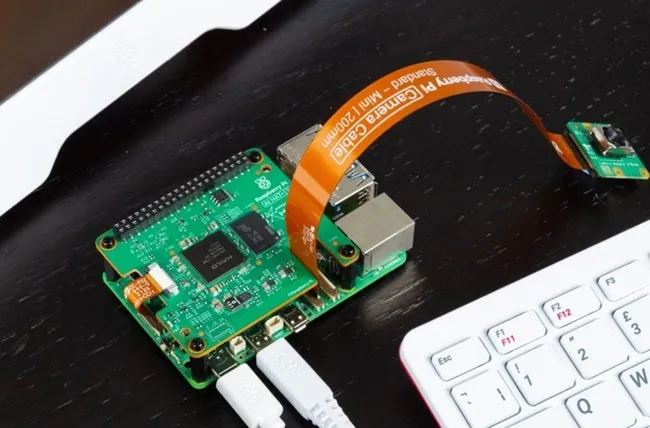
Note there is a Raspberry Pi guide for help in setting it up. And Hailo’s GitHub repo is a resource for examples, demos and frameworks, for both vision- and GenAI-based applications.
The original AI HAT+ was introduced in October 2024.
Images: Raspberry Pi