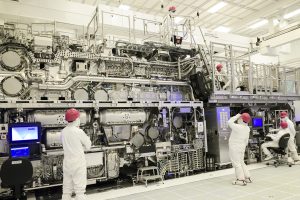
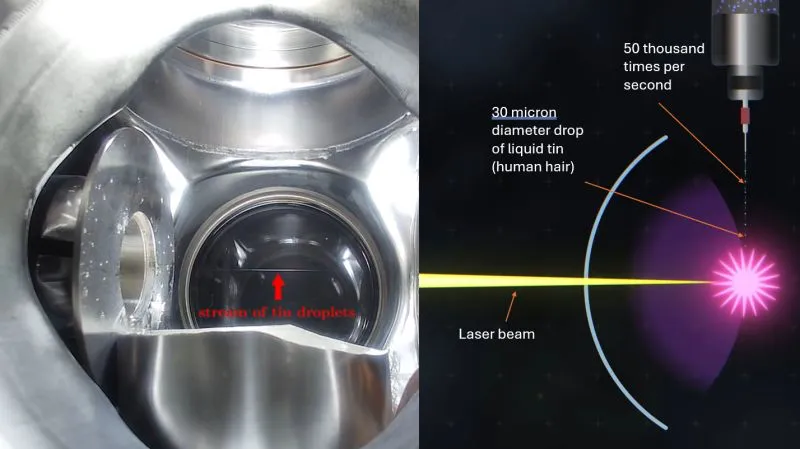
The advance has been achieved by doubling the rate at which the molten tin drops in an EUV machine are exposed to a CO₂ laser beam to create plasma that emits EUV radiation.
By doubling the droplet rate to 100,000 per second and using a two-pulse laser shaping approach instead of single pulse, the light source was boosted from 600W to 1000W.
“It’s not a parlour trick or something like this, where we demonstrate for a very short time that it can work,” Michael Purvis, ASML’s lead technologist for its EUV source light, told Reuters, “it’s system that can produce 1,000 watts under all the same requirements that you could see at a customer.”
ASMl sees a route to 1500W and then to 2000W.
The company shipped eight high-NA machines last year at $380-400 million each, and intends to ramp production to 20 a year by 2027/8.