

It sees potential in developing the UK’s role in space-enabled manufacturing via a well-defined pathway. And such In-Orbit Manufacturing (IOM) is also one subset of the wider In-Orbit Servicing, Assembly, and Manufacturing (ISAM) market.
The joint statement was issued by the UK Space Agency, the Medicines and Healthcare products Regulatory Agency (MHRA), the Regulatory Innovation Office (RIO) and the Civil Aviation Authority (CAA).
The organisations say they are working to provide “a supportive regulatory environment to space, biopharma and pharmaceutical companies through collaborative work on guidance, regulatory sandboxes, case studies and supply chain engagement”.
The statement reads:
“In-orbit manufacturing of pharmaceuticals offers transformative potential across multiple domains, from precision medicines for oncology and rare diseases to drug stability for remote and crisis-affected populations. This reinforces the UK’s commitment to enabling innovation in pharmaceutical manufacturing.”
“This includes supporting the development of novel modalities that could enhance drug quality, improve supply chain resilience and unlock new therapeutic possibilities for patients. As this sector evolves, the UK remains focused on ensuring the highest standards of safety, quality and regulatory compliance, creating a clear and supportive pathway for innovators while safeguarding public health.”
IOM
According to the staement, the UK’s legislative frameworks for human medicines and spaceflight activities represent an opportunity to demonstrate a clear end-to-end regulatory pathway for UK in-space manufactured pharma products.
The CAA and UK government are also exploring opportunities to streamline spaceflight licensing processes. Particularly to support larger-scale, higher cadence operations.
Potential applicants for UK In-Orbit Manufacturing platforms will engage with the CAA.
Regulatory clarity
 “In-orbit manufacturing of pharmaceuticals represents a significant opportunity for the UK, combining the growth potential of our space sector with the promise of better treatments for patients,” commented Lord David Willetts, Chair of the UK Space Agency and Regulatory Innovation Office.
“The UK Space Agency is committed to supporting the companies pioneering this work, from microgravity platform providers to biotech and pharmaceutical firms. Setting out a clear adoption pathway with well-defined regulatory requirements gives investors and entrepreneurs the confidence they need to bring these innovations to market. The UK is open for business in space-enabled pharmaceuticals, with the ambition and capability to lead globally.”
BioOrbit
As we previously reported in February, the UK Space Agency (UKSA) is funding three UK companies. This is to investigate producing advanced materials in Low Earth Orbit (LEO).
BioOrbit was one of the three. It won an award of £250,000 to carry out the ‘PHARM’ study. This will design an end-to-end mission to manufacture drugs in microgravity.
The UKSA states BioOrbit is working with relevant regulatory bodies to ensure the commercialisation of such missions are possible.
Microgravity enables the formation of more perfect, reproducible protein crystals for drug formulations not possible on Earth.
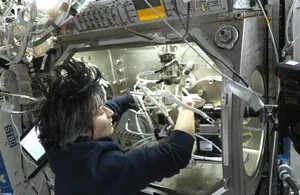
Image: (top) BioOrbit (bottom) NASA – ESA astronaut Samantha Cristoforetti working on pharmaceutical research on the International Space Station
See also: Space-Comms Expo: UK gov promises £500m for national space programmes