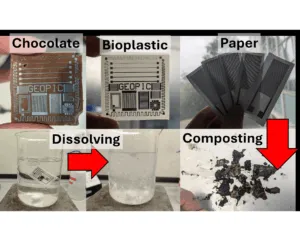
Instead of conventional circuit boards that are sent to landfill, adding to the problem of electronic waste, the team has developed a method to print zinc-based electronic circuits on environmentally-friendly surfaces such as paper and bioplastics, which are mostly biodegradable. It says that 99% of the circuit can be dissolved in household chemicals such as vinegar or by ordinary soil composting.
The team developed a ‘growth and transfer additive manufacturing process’, which replaces copper with zinc for circuitry. The zinc is electroplated in 5µm wide tracks onto a temporary carrier, which is then transferred to a biodegradable base.
The circuits perform comparably to traditional boards, said the researchers. The paper, published in Communications Materials, shows successful testing on many devices, including tactile sensors, LED counters and temperature sensors. The team has also shown that the materials’ performance remains stable after more than a year kept in ambient conditions.
A life cycle assessment comparing the new PCBs against conventional ones found that the biodegradable PCBs could contribute to reducing the environmental impact of electronic devices and e-waste. It suggested they could enable a 79% reduction in global warming potential and a 90% reduction in resource depletion.
Dr Jonathon Harwell, of the University of Glasgow’s James Watt School of Engineering and the paper’s first author, said: “The work demonstrates a major step toward circular electronics, where devices are designed from the outset for reuse, recycling, or safe degradation.”
The paper’s corresponding author, Professor Jeff Kettle from the James Watt School of Engineering, added: “One key aspect of our work is that almost any substrate material can be used .. . from paper and bioplastics for more realistic applications, to chocolate for tasty but probably not very practical demonstrations.
“We are now exploring ways to adapt this technique to other fields such as mouldable electronics or biosensing, which could also benefit from a cheap and versatile way to make high quality circuits with low environmental footprints.”
EW BrightSparks 2025 profile: Nikolas Bruce, University of Glasgow