
 “E-textiles and wearable electronics can enable diverse applications from health care and environmental monitoring to robotics and human-machine interfaces,” said Virginia Tech engineer Michael Bartlett. “Our work advances this by creating iron-on soft electronics that can be robustly integrated into fabrics.”
The key element is a mixture of gallium-indium alloy liquid metal droplets and polyurethane rubber.
Poured onto a surface and air dried for a day, it forms a soft, electrically-conductive elastic sheet.
This is cut up into lengths that will become conductors, and it is these that have been ironed-on to various fabrics.
“The polymer in the conductive patches created strong bonds with the fibers, keeping the layers together once they cooled,” according to the university.
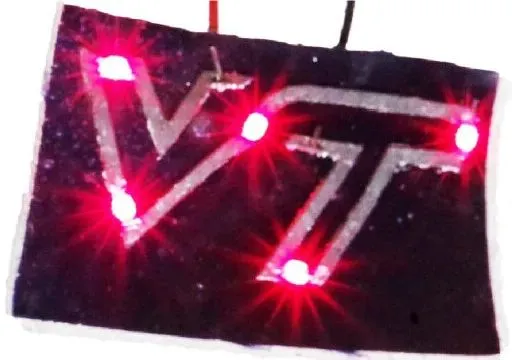
In one technology demonstrator (pictured), the university’s logo was ironed onto fabric with five LEDs – LEDs that continued to operate when the fabric was repeatedly folded, twisted and stretched.
Another fed power into, and signals out of, microphone within a shirt.
“The ironed-on microphone recorded sound across the full human hearing range with performance comparable to a traditional microphone setup, and with less noticeable bulk,” said the university.
The work is described in ‘Iron-On Wearable Electronics through Liquid Metal Adhesive Composites‘, published in ACS Applied Materials & Interfaces, from where the image was copied with permission.
Image credit: Adapted from Applied Materials & Interfaces 2025, DOI: 10.1021/acsami.5c13752



But what wash cycle will they withstand?