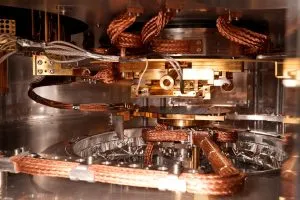
The NanoIC pilot line, a European initiative coordinated by imec and dedicated to accelerating innovation in chip technologies beyond 2nm, announces the release of two new process design kits (PDKs): an A14 pathfinding PDK for advanced logic scaling and an eDRAM system exploration PDK for advanced memory innovation. Both PDKs are first‑of‑their‑kind releases, providing early access to cutting-edge design rules and ...
Research
The latest electronics research news from within the industry and universities from around the world.
EU quantum effort
The EU is putting up €25m to pursue superconducting quantum technologies via a consortium called SUPREME. It is made up of: Alice & Bob, Amires, Arctic Instruments, Bayerische Akademie Der Wissenschaften, CEA, Delft University, Fondazione Bruno Kessler, Fraunhofer Gesellschaft, IFAE, Infineon, IQM, Leibniz Institute, Max-Planck-Gesellschaft, Peak Quantum, Qilimanjaro QphoX, Quantum Tech, QuantWare, Silent Waves, Silicon Austria Labs, Single Quantum, The ...
CEA-Leti’s open access pilot line
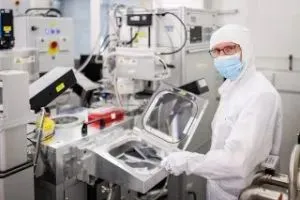
CEA-Leti’s €830 million FAMES semiconductor pilot line in Grenoble has been inaugurated. It is running FD-SOI wafers for RF, NVmemories and PMICs. The open-access line is accessible primarily, but not exclusively, to European startups, SMEs, industrial groups, and research organizations seeking to prototype, qualify, and de-risk advanced semiconductor technologies before industrial deployment. “The technologies developed within FAMES are intended to ...
MPL and Fraunhofer applying SiC to PICs
In the ALP-4-SiC project – Atomic Layer Processing for SiC for Applications in Photonics and Quantum Communication – researchers from the Max Planck Institute for the Science of Light (MPL) and the Fraunhofer Institute for Integrated Systems and Device Technology IISB are jointly developing basic technologies for the production of photonic integrated circuits (PICs). Using optical waveguides and ring resonators ...
Imec and Veeco integrate BTO into SiPho process
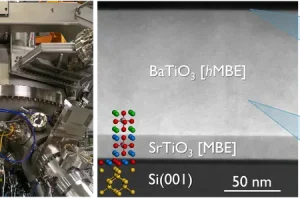
Veeco Instruments and imec have developed a 300mm high volume manufacturing compatible process that enables the integration of barium titanate (BaTiO3 or BTO) on a silicon photonics platform. At present, there is no commercially available production-compatible solution for manufacturing these materials. BTO is a promising material with unique electro-optical properties that can be used for high-speed and low-power light modulation ...
UCB celebrates graduates of automotive battery manufacturing course
University College Birmingham (UCB) is celebrating the first cohorts of students through both its Advanced High Voltage (HV) Battery Assembly and Gigafactory Operations courses. Specifically, attendees from Jaguar Land Rover, Atlas Copco and Autocraft graduated from a dedicated learning facility within the UCB. The five day courses are described by the university as the first, fully accredited, advanced battery courses ...
Memristor + touch sensor for energy-efficient memory
A research team led by Massachusetts University has integrated a touch sensor with a memristor for a device that only only processes data around pixels that contain a signal while ignoring irrelevant background noise. “When you write, it’s only a very small portion [of pixels] that are involved,” said Qiangfei Xia, the Dev and Linda Gupta professor in the Riccio ...
Animated origami material developed
Researchers at McGill University have developed ultra-thin materials that can be programmed to move, fold and reshape themselves like animated origami. They open the door to softer, safer and more adaptable robots that could be used in medical tools that gently move inside the body, wearable devices that change shape on the skin or smart packaging that reacts to its ...
Glasgow has compostable circuit board design licked
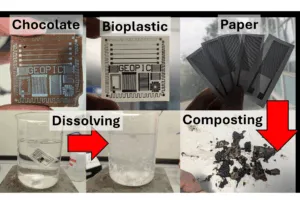
Circuit boards that are almost entirely biodegradable have been developed by researchers at the University of Glasgow, electroplating circuitry onto compostable substrates – including chocolate. Instead of conventional circuit boards that are sent to landfill, adding to the problem of electronic waste, the team has developed a method to print zinc-based electronic circuits on environmentally-friendly surfaces such as paper and ...
Birmingham Uni launches rare earth magnet recycling facility
The University of Birmingham and HyProMag USA, which is 60% owned by the US rare earth specialist CoTec, have launched a facility for separating and recycling rare earth magnets that will help to reduce the UK’s reliance on imports of rare earth metals, alloys and magnets. Opened by Chris McDonald MP (pictured), Minister for Industry in the Department for Energy Security and ...
Electronics Weekly