Growth is expected to moderate in 2026. With China’s market expansion slowing, global EV sales are projected to reach 23.4 million units, representing a reduced growth rate of 14% YoY.
China accounted for approximately 66% of global EV Q2 sales in 2025. However, its annual growth slowed to 24% due to a high comparison base, putting it slightly below the global average.
Western Europe, in contrast, recorded nearly 30% YoY growth, marking its strongest performance since 2022.
In the 2025 BEV rankings, BYD (brand) posted approximately 25% YoY growth, overtaking Tesla to claim the top position.
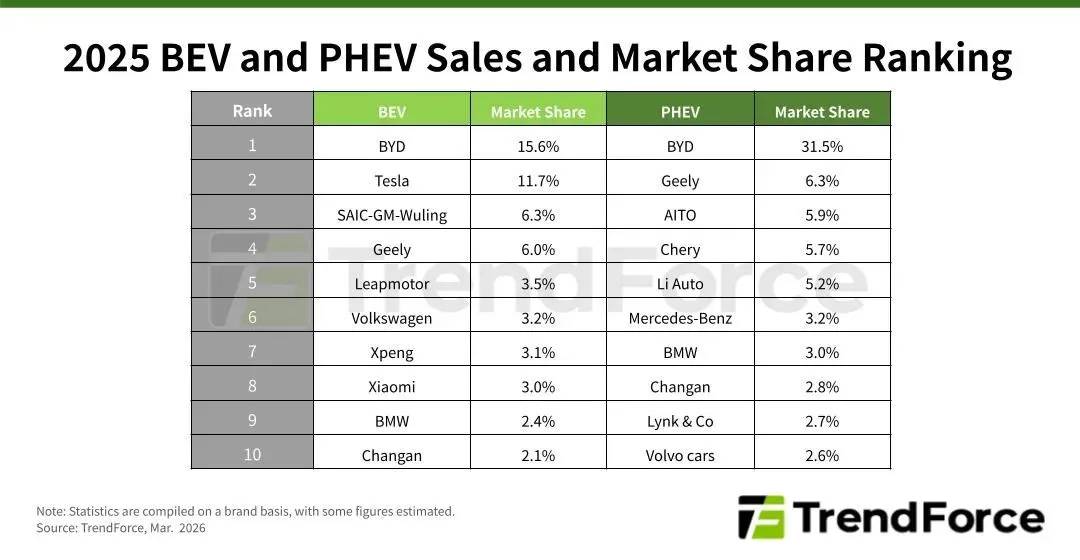
Tesla experienced an estimated 9% annual decline, reflecting limited momentum in product refreshes.
SAIC-GM-Wuling maintained third place, while Geely climbed to fourth, driven by strong demand for its sub-CNY 100,000 Xingyuan model. Geely’s market share surged from 3% to 6%.
Xiaomi also saw rapid gains, doubling its share from 1% to 3% to rank eighth.
Although Volkswagen recorded overall sales growth, continued weakness in China led to a decline in ranking and market share. In an effort to reposition itself, Volkswagen launched its China-focused sub-brand ID.UNYX and deepened collaboration with Xpeng.
Jointly developed models will enter the market in 1Q26, marking a strategic reset in China.
Geely rose to no.2 in the PHEV segment on Galaxy Series strength.
In the PHEV segment, BYD maintained leadership with approximately 31.5% market share in 2025. However, it recorded its first decline in both sales volume and share, while group-level share stood at around 36%.
Geely advanced to second place with 6.3% share, supported by its Galaxy lineup. Both BYD and Geely, as large automotive groups, benefit from strong cost control and advantages in resource integration.
By contrast, Li Auto, the 2024 runner-up, faced intensified competition in China and slower overseas expansion. Its 2025 sales fell approximately 30%, dropping to fifth place. The company is ramping up investment in AI-driven vehicle technologies to regain competitiveness.
TrendForce highlights significant policy changes across major markets in 2026:
- China is shifting subsidies from fixed-amount incentives to price-based percentages, potentially disadvantaging lower-priced models.
- The United States will no longer provide federal EV subsidies.
- Germany has reinstated subsidies without country-of-origin restrictions, which may benefit Chinese-made EVs.